My grandparents gave me a copy of Irvine Welsh's Trainspotting for my fourteenth birthday. I've never asked why the retired vicar and headmistress decided that it was time to acquaint me with the world of the criminal underclass. But once I entered that fictionalised world, I was hooked. I read everything else I could find by Welsh. I read Burroughs, Wolfe, Kesey, Kerouac, and numerous lesser authors who described this intensely exciting and seedy side of life. I revisited chapters of Trainspotting and read it through several more times. I got some way into an unfinished project to map out the relationships between all the characters, no matter how minor, in Welsh's Edinburgh (and London, and Amsterdam).
And when the movie appeared a couple of years later, I became obsessed with that too. Its soundtrack — Elastica, Blur, Sleeper, Leftfield — was already my soundtrack. Because of Pulp's song there is a photo of me at 16, awkwardly leaning against a station sign in Mile End tube station. Thirteen years later I lived there for a few months, and still enjoyed the association.
My obsession waned, but I've continued to read many of Welsh's books including Porno, and the more recent prequel Skagboys. (T2 draws on both of these, as well as parts of Trainspotting that didn't make it to the original movie.) And so in T2, when Sick Boy tells Begbie that Gav Temperley spotted Renton in an Edinburgh bar, I knew that Gav was distinguished by being one of few Welsh characters with a legitimate employment. He used to work for the dole office; I wonder what he's doing now.
So I had a deep stake in whether T2 was worthy of the name. And it isn't just the sequel whose reputation is at stake. A poor follow-up can taint the original forever. When I lived in Mile End, I went to see Kick-Ass twice; it was screened every few months after that in my home. But since we saw the mediocre follow-up, our bluray copy of Kick-Ass has languished in the attic, buried in an unmarked grave with Down in the Valley, Million Dollar Baby and others unlikely to make a reappearance on a rainy weekend afternoon.
Any reader still here, whether through patience or loyalty, may be asking why I'm claiming that this is a review of T2 rather than a rambling piece of personal nostalgia. It's a good question. It's the same question I was asking myself after the first half-hour of T2. I was worried. It seemed to be
indulging and manipulating its audience's memories lazily, recapitulating themes and events without injecting
anything exciting and new.
But now I realise that I'd misunderstood. As it continued, T2 drew me completely back in. Renton, Sick Boy, Spud and Begbie are so believably the projection of their former selves into the present day that I sank back into 2-for-1 cinema seat and lost myself in the drama. I left the cinema exhilarated, nostalgic, and content.
I don't know whether T2 would have as powerful an effect on those whose teenage years weren't so dominated by its predecessor. But if you're anything like me, you should go and see it — at the cinema — at your earliest opportunity. You know your twenty-years-younger version would insist on it.
Saturday, 11 February 2017

Friday, 9 September 2016
David Brent: Life on the Road
Ricky Gervais, 2016
Life is a boring burden. Shouldering it is relieved only occasionally and fleetingly by a moment of meaning. You can't create these moments for yourself; they arrive only by chance or through others' acts of mercy.
This vision of existence depicted in Life on the Road doesn't differ much from the vision in The Office. But now that David Brent is a decade adrift from the social structure of Wernham Hogg, he can no longer rely on his colleagues' occasional sympathetic participation in these life-affirming encounters.
Unfortunately this means no more Tim Canterbury, one of few characters with insight in The Office, whose functions included interpreting events for the viewer in the show's characteristic head-shot monologues. Instead Brent has to supply the philosophy himself. That would be fine if he hadn't also descended further into the depths of ham-fisted cluelessness: the film sees him renting session musicians to join him on a 'tour' of various jam nights and crap pub gigs in and around Slough, all the while waffling about bagging a major label contract. So when he shifts into Werner Herzog mode, it's a bit jarring. As are the occasional moments that deliberately reference popular jokes from the TV series. Life on the Road is still a mock-doc, and anything that pulls the viewer out of that is a moment of failure.
Having said all that, Life on the Road does have some great jokes, scenes of redemption, and an open ending that suggests that Brent might finally make peace with his place in the world and begin to build a happier life around it.
But that's also a problem, for this prospect seems hollow when you recall the structurally similar epiphanies and possibilites at the end of The Office's Christmas episodes. They really should had been the end of the David Brent story. This film, well-made, poignant and enjoyable as it is, sullies the ending of the TV series, presenting a bleaker vision of Brent's future. It may be capturing the zeitgeist, but it left me with a heavy heart.
Wednesday, 1 February 2012
The Girl with the Dragon Tattoo
David Fincher, 2011
BBFC rating: 18

I tend to think of actors as being like football managers: they need a reasonable level of competence, but those who've attained that level are more or less interchangeable. There are a couple of exceptions - I'll probably give a film a second glance based solely on its cast's including Willem Dafoe or Chloë Sevigny. But it's rare that a character seems so important that the actor chosen for the role is critical - after all, Daniel Radcliffe's Harry Potter is mediocre at its peak, but that doesn't spoil the movies for me.
However, having seen the original Swedish adaptations of The Girl... series - in which Noomi Rapace plays Lisbeth Salander, the eponymous female lead, to a tee - it seemed likely that this new version was going to stand or fall on the basis of Rooney Mara's take on the role. Fortunately, she does it very well indeed. She sulks, hacks, seduces, and zips about on an extremely cool motorbike, with style and attitude. Everyone else pays their part convincingly well enough, and the script, cinematography and pace are all about right - the latter, notably, despite this film's length of almost 150 minutes. It also retains the darkness and brutality of the source material, hence its 18 certificate.
Still, this was true of the original Swedish version of the film. I definitely enjoyed the American version more, but that's probably because it's now been over two years since I read the book, so the story seemed fresher - whereas I saw the Swedish version at the cinema in the afternoon after finishing the book that morning. The American version is better in its choice of graphic design and props, but the original wins for being in Swedish where the characters in the remake speak English in a variety of Scandinavian accents - bar Daniel Craig's Blomkvist who, oddly enough, has the actor's regular English accent. It would have been better for all the characters to do the same. I think the film just about gets away with this defect, and it's an otherwise very good adaptation of an excellent, exciting story. But I don't think I could recommend it over the original.
Friday, 21 October 2011
Drive
Nicolas Winding Refn, 2011
BBFC rating: 18

Having recently spent time driving in and around LA, I found the landscape gave me the excitement of vague familiarity and, frankly, I would have been happy just watching the scenes shot from our hero's bucket seat for minutes at a time. Fortunately for everyone else, none of these sections last long except in the less prosaic sequences where Gosling races and hides from the pursuing police like a naughty kitten intent on staying out after dark. The action builds, swells and breaks with a natural rhythm over the course of its 100 minutes, as its characters cross and backstab each other while the stakes rise along with the body count.
The only minor problem with Drive is that it's shot digitally, which means it suffers from the same distracting pixellation artefacts as other digital films. Of course that won't matter for the home video market (unless you've got a 15-foot tellly). But this was the only negative thing I could think of about Drive. It's The Fast and the Furious with guts, balls and acting; Taxi Driver plus Death Proof plus tension. Unmissable.
Picture credit: Pierrot Neron. Picture appropriated from the facebook fan page, which includes other such posters designed by the general public.
Sunday, 2 October 2011
Tinker, Tailor, Soldier, Spy
Tomas Alfredson, 2011
BBFC rating: 15

Wednesday, 21 September 2011
Kill List
Ben Wheatley, 2011
BBFC rating: 18

What makes the difference between a horror movie and a thriller? I think in many cases it's all in the ending. Films about the main players being trapped - like Buried and Frozen - would be thrillers if they culminated in escape and horror films if they didn't. This could depend on as little screen time as the final 15 or so seconds. Thrillers and horror movies often rely largely on tension ratcheted up over the course of the film, giving the audience time to acclimatise to the baseline and get to know and invest in the characters - to magnify either the horror when it arrives, or the sense of vicarious relief when it doesn't. Kill List straddles the thriller/horror boundary, moving across toward the latter as the film progresses. I can understand why it has been described variously as one or the other (and as the ambiguous 'chiller' in the quote on the promo poster above).
Much like Skeletons and The Disappearance of Alice Creed (a similarly brutal and enthralling movie), Kill List centres around the relationship between two male characters. The three also have in common low budgets, stark British landscapes and a melancholic tone as well as convincing acting, intriguing plots and fairly limited cinematic releases. My guess is if you like them, you'll like this too - as long as you don't mind a splash of horror with your thrills and drama.When the horror finally arrives, it's nicely done: jeopardy, chases, and blood and guts are all present, correct and stylish and the horror has overtones of A Serbian Film, The Wicker Man and The Last Exorcism. It's not quite got the conceptual strength to linger for ages in my mind like Martyrs did, for example, but it certainly has the balls and the guts to induce the queasiness and dread the poster promises.
Thursday, 2 June 2011
Senna
Asif Kapadia, 2010
BBFC rating: 12A

Documentaries examining motorsports, including their attendant tragedies, are popular this year, with Closer to the Edge still in cinemas as Senna is released. Sadly, this year's Isle of Man TT has already seem fatal accidents with a sidecar partnership both killed in practice earlier this week. Motorcycle racing is not the only dangerous sometime-road-based sport around, however. Last weekend's Monte Carlo grand prix gave us viewers a timely reminder that driving open-wheel sports cars round tight circuits at 200mph can be dangerous too. Sergio Perez's crash in the third qualifying session saw the first time since Felipe Massa's Hungaroring incident in 2009 that a driver remained in the car for minutes after coming to a stop with injuries of unknown severity - a tense scenario which fortunately had a happy ending on Saturday, as did Vitaly Petrov's less spectacular but still potentially nasty crash in the following day's race.
In fact anyone who pays any attention to Formula 1 will already know that Ayrton Senna, the Brazilian three-time champion, was the last driver to be killed in an F1 crash. Fewer people are likely to be aware of the internal politics and the macabre aura over that race weekend, and no-one had seen until this film the footage of Senna's backroom srguments with FIA bosses during pre-race driver's meetings, in which he pleaded for changes to be made to tracks to improve safety. In the post-screening Q&A at the preview I attended, the director said he saw footage of Senna criticising the specific corner on which his fatal accident later took place. However, he decided not to include that in the film - given the number of track features Senna remarked upon during his time in racing, he thought cherry-picking that footage would have added drama at the expense of authenticity.
I thought that was very admirable. And Senna is definitely authentic. The visuals are stitched together entirely from footage of Senna and, although there's the occasional snippet of interview voiceover to set context or explain what we're seeing, the story largely tells itself. The combination of previously unseen backstage footage and clips of classic F1 races on the big screen was for me entirely compelling. I thought the fact I found it hard to imagine anyone having a different reaction might just be down to my lack of imagination but surely not every reviewer who contributed to its 100% Rotten Tomatoes rating can also be a motorsport geek. In fact, even sport-hater Mark Kermode commended it on his 5Live show. Recommendations don't come much better than that.
Sunday, 22 May 2011
Closer to the Edge
a.k.a. TT3D
Richard de Aragues, 2011

A couple of months ago the BBC broadcast a documentary about 'the killer years' of Formula 1 (here's a link to the first part on youtube). It documents how, in the 1960s and 70s, drivers were frequently killed in racing incidents. Their cars were fast but flimsy, easily breaking into pieces - which could then fly into the cockpit - or bursting into flames. The tracks were lined with trees and walls - rather than gravel run-off for a more gentle stop - and haybales, leading to spectacular inflagrations. The drivers lacked the fireproof suits and head-and-neck-support systems which nowadays prevent them from burning alive and snapping their spines respectively. F1 now has far fewer sickening moments and even fewer serious injuries. No-one's died in a crash since 1994, the year Ayrton Senna - the subject of a documentary opening on 3 June - was killed in San Marino.
The same cannot be said for motorcycle racing. Its competitors are prone to being flung from their vehicles - occasionally into the path of their competitors - and lack a surrounding chassis to absorb impact energy. Most track motorcycle races are, however, held on circuits with similar safety features to those used in F1: Armco crash barriers, tyre walls, long run-off areas at corners. No such luxuries for those who race for the Isle of Man tourist trophies every June, though. This circuit round the roads of the island is lined with the features of everyday driving - houses, walls, lampposts - but the top racers average 130mph round the circuit, hitting 200 plus on the straights.
Shot in the lead up to the 2010 Isle of Man racing festival, the movie culminates with tense footage from the five main races of the weekend. The hero of sorts is Guy Martin, a straight-talking northern mechanic who loves fixing lorries, masturbating and, most of all, racing motorbikes. He's like a two-wheeled Karl Pilkington (a thought I was dismayed to discover wasn't an original one), with probably more self-awareness than he lets on but plenty of charisma and casual confidence in his singular worldview. Before 2010, he's had podium (top three) finishes in several TTs but hasn't won one - he's determined to put that right this year.
Since I had no idea what happened at the 2010 TT before I went to see this film, I found it as exciting and suspenseful as watching the action live would be. I'd strongly recommend anyone thinking of seeing it to do so without researching the results beforehand. Guy Martin is not the only rider the film-makers interviewed; there are many others, and the tension comes not only from wondering whether the riders you've met will win, but whether they'll survive - intact or otherwise. It's not giving much away to say that one or two of the later interviews' subjects are filmed talking from their hospital beds.
Closer to the Edge has a perfectly-balanced combination of race footage, backstage events and personal stories. Run by enthusiasts, populated by amateur riders and providing nail-biting thrills for spectators, the TT was so well showcased by this film that I'm now wondering how best to make it over to watch next year's in person.
Thursday, 31 March 2011
Noruwei no mori
a.k.a. Norwegian Wood
Tran Anh Hung, 2010. BBFC rating: 15.
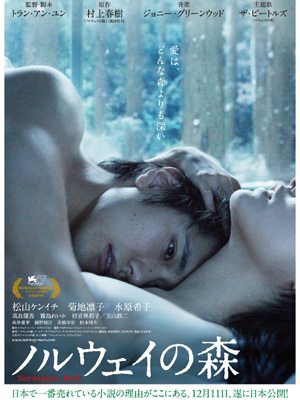
Being a teenager is rubbish. This film gets that right - though really these kids should, by the age they've reached (which seems to be about 19), have at least begun to grow out of the stage of sulking and sobbing. On the contrary, however, the kids in Norwegian Wood spend their time moping, crying, walking melancholically around fields, killing themselves, and having awkward, miserable sex. Sometimes they combine these activities.
And they're the lucky ones. At least adolescent angst is interesting to the angstee: what's in it for the audience? Well, we get some pretty cinematography. But that's about it. There's the occasional laugh, no doubt unintended by the director, as when our hero stands on a cliff screaming at the sky to the backing of a screeching orchestra. (Yes, really.) The score is awful - grating, hammy, and distracting. Apparently it was put together by Jonny Greenwood off of Radiohead, which makes it rather a fall from grace for him.
Mind you, the film is actually rather reminiscent in tone of early Radiohead. Take "Street Spirit" with its adolescent, portentous and surely in retrospect embarrassing lyrics ("cracked eggs, dead birds, scream as they fight for life": 'cause if you're 14, you know that life's really all about death), which is tonally similar to this. There are two major differences, however. First, "Street Spirit" is shimmering and evocative, unlike either the music or the narrative of Norwegian Wood. And, more importantly, it lasts just over four minutes. Norwegian Wood lasts over thirty times that long. Avoid.
Monday, 28 February 2011
Never Let Me Go / Splice / Legion
I have seen a couple of newish films recently so I'll quickly share my views on them.
First up is Never Let Me Go, the adaptation of Kazuo Ishiguro's 2005 novel of the same name. The novel is pretty much perfect - allowing the reader a glimpse of an other (but not very other) world through the eyes of a character immersed in a small part of it. She gets only small clues, the significance of which she rarely understand, and it's left to the reader to infer the science behind the fiction. Unfortunately the film is a little more explicit about that than the novel - some things that should be left to the viewer to infer are presented directly instead - though not to the extent that it spoils what is an excellent adaptation. Like the book, the movie is all about its three main characters and their love triangle. And I was relieved to find that the song after which the book is named is up to the job it has in the film.
Splice, which I missed at the cinema and caught recently on bluray, is altogether different. Science in this is a case of throwing lots of exciting data and cells and swirling nucleotides around, mixing them all up, and seeing what happens. It's as close to the reality of genetic engineering as Hackers was to the reality of bypassing network security. It's really nicely shot - lots of great low angle shots of labs and shacks - and it has a good monster (secretly created by the rockstar science bods in an act of rebellion when their boss asks them instead to make boring proteins all day). Fun, but very silly.
Not as silly as Legion, mind you, which I just watched on bluray. This is The Terminator meets From Dusk til Dawn meets the nativity story. Except even more portentous and absurd than that sounds. Still, again, it's pretty good fun.
First up is Never Let Me Go, the adaptation of Kazuo Ishiguro's 2005 novel of the same name. The novel is pretty much perfect - allowing the reader a glimpse of an other (but not very other) world through the eyes of a character immersed in a small part of it. She gets only small clues, the significance of which she rarely understand, and it's left to the reader to infer the science behind the fiction. Unfortunately the film is a little more explicit about that than the novel - some things that should be left to the viewer to infer are presented directly instead - though not to the extent that it spoils what is an excellent adaptation. Like the book, the movie is all about its three main characters and their love triangle. And I was relieved to find that the song after which the book is named is up to the job it has in the film.
Splice, which I missed at the cinema and caught recently on bluray, is altogether different. Science in this is a case of throwing lots of exciting data and cells and swirling nucleotides around, mixing them all up, and seeing what happens. It's as close to the reality of genetic engineering as Hackers was to the reality of bypassing network security. It's really nicely shot - lots of great low angle shots of labs and shacks - and it has a good monster (secretly created by the rockstar science bods in an act of rebellion when their boss asks them instead to make boring proteins all day). Fun, but very silly.
Not as silly as Legion, mind you, which I just watched on bluray. This is The Terminator meets From Dusk til Dawn meets the nativity story. Except even more portentous and absurd than that sounds. Still, again, it's pretty good fun.
Sunday, 6 February 2011
Black Swan
Darren Aronofsky, 2010.
BBFC rating: 15.

There's a book by called The Black Swan about 'the impact of the highly improbable'. It may be full of interesting facts and astute analysis, but I will never know because the first few pages, which are all I managed, are such an absurdly over-written, insufferably smug, self-congratulatory wankfest that I threw the book into the bin lest some other unfortunate soul should find it and suffer the same blood-boiling rage that I did. This has nothing to do with Black Swan, a far superior piece of work; I am simply providing a public service by warning you off its awful titular twin.
Black Swan tells the story of Natalie Portman's obsessive, uptight ballet dancer and her struggle to embody the dark side of her Swan Lake character. It has a fairly straightforward horror movie narrative: we are introduced to the characters and follow them around for half an hour or so before the occasional strange happenings multiply and intensify, accelerating us towards the inevitable conclusion. Though clearly belonging in the psychological horror category, Black Swan was featured on the cover of high-end coffee table film mag Little White Lies as well as grindhouse periodical Fangoria: it has transcended the genre, such that several unsuspecting souls have found themselves traumatised at the end of a film they anticipated would be a nice family ballet movie. It's not. But, while its sticking to horror convention makes its plot predictable - as with many such movies (including Heartless, of which it rather reminded me) - that is no bad thing. It is, of course, all about the journey - which is well worth making.
Saturday, 29 January 2011
127 Hours
Danny Boyle, 2010
BBFC rating: 15

An oppressive feeling of foreboding hangs over me ... This is it ... I have to think through the only possible way out: to operate on myself ... It’s almost impossible ... but I can’t just fold my arms and give up...
I didn’t permit myself to think about anything other than the task at hand. It was necessary to steel myself, steel myself firmly and grit my teeth...
I grow weaker and weaker, my head starts to spin. Every 4-5 minutes I rest for 20-25 seconds. Finally, here it is, the cursed appendage! With horror I notice the dark stain at its base. That means just a day longer and it would have burst...But even this looks controlled and safe compared to the 'operation' Aron Ralston carried out on himself five days after his arm became trapped under a huge boulder down a crevice in the middle of a desert. He had to deliberately break both bones in his forearm before cutting through the muscle, blood vessels, tendons, nerves and probably various other tissues that would be very painful to snip using a blunt penknife. 127 Hours, as its title implies, tells the story of what happened over that period. Now the story above might make you wince in sympathetic agony, imagining the horror of being faced with the choice between that and death yourself. Or you might agree with Michael Legge (I usually do; his blog is brilliant, the best written by a comedian that I know of) who has a less sympathetic take on the scenario:
The whole way through the film your head can't help shouting "YOU STUPID FUCKING PRICK" constantly. Who the fuck does these things? Who invented extreme sports? Why is smashing yourself to bits thought of as a rush? Isn't Batman on the Wii enough? 127 Hours is a true story about a man who likes going into the middle of the desert, WHERE NO ONE CAN FIND HIM, and climbing deep down into tiny crevaces hundreds of feet into the rock. WHAT A CUNT. I hate him. When he falls, traps his arm and spends six days going insane until he cuts his own arm off, it was all I could do to stop myself standing up and shouting "THERE YOU GO, YOUNG MAN. YOU DESERVED THAT..."I can see his point.
As Ralston waits to die - slim chances of rescue slipping away - he remenisces about an ex-girlfriend, played by Clémence Poésy (seen recently in Harry Potter and Heartless), whose presence would brighten any film. Like The King's Speech, this is a true story so its narrative and conclusion are unlikely to surprise anyone. The only mystery is how Boyle is going to make it interesting. Which he does, with brass knobs on. It's certainly more interesting than reading interviews with Ralston himself, who seems to largely blather on about fate and Gaia and spirituality and other such drivel. 127 Hours is totally gripping, in part because of the memory sequences and the hallucinatory sections (which play out much like the cold turkey scenes in Boyle's Trainspotting). But it's also remarkable just how enthralling the footage of a man stuck under a rock manages to be.
Friday, 28 January 2011
The King's Speech
Tom Hooper, 2010.
BBFC rating: 12A (on appeal)

For anyone who doesn't already know, The King's Speech depicts the relationship between King George VI and his speech therapist over the period in which he ascends to the throne and the start of the second world war is declared. The reason Bertie (as he is known to his familiars and, to his chagrin, the therapist) needs the therapist is his stammer, which has destroyed any previous attempts he's made at public speaking (whether in person or on the radio).
It's interesting for being one of few films to have its initial rating overturned on appeal. Given a 15 certificate at first for language, its rating was dropped to 12A after the producers challenged the BBFC. The key line from the second decision, I think, is "The strong language is not aggressive and not directed at any person". This is the difference between The King's Speech and Made in Dagenham; the producer of that film complained about its 15 certificate, too, but the BBFC's decision on that film notes that "Generally the uses [of 'fuck'] occur as part of heated exchanges between characters, occasionally they are angrily directed." It's the intent and the subject of the speech that matters. And Bertie is expressing only his own frustration, about his inability to express himself, at himself.
Colin Firth is expected to win the Oscar for this performance, and he indeed wholly convincing - as he was in last year's A Single Man. And, like that film, The King's Speech is a self-contained piece, as narrowly focused as the poster picture above, which perfectly achieves its aims. However, it's weirdly insubstantial, especially given the gravitas of its subjects. Possibly this is because, as Andrew Collins points out, there is not a surprise in its entire length. And it's not a film I would ever bother seeing again; nor is it one that needs to be seen at the cinema. But it's good while it lasts.
Wednesday, 19 January 2011
Love and Other Drugs
Edward Zwick, 2010.
BBFC rating: 15.

In Love and Other Drugs Jake Gyllenhaal plays Jamie, a university drop-out from a family of doctors who is hired as a trainee drug rep by Pfizer. His job largely consists of trying to persuade medics to drop Prozac in favour of Zoloft, while his principle leisure activity is seducing countless women. Sometimes the two parts of his life overlap. He gets involved in an unlikely love triangle with Maggie (a client's patient, played by Anne Hathaway) and an ex-military rep from a rival pharma firm. Meanwhile, there are rumours about a forthcoming drug for erectile dysfunction. Suiting perfectly his work-life balance, Viagra is the drug he was born to push. But might Jamie also be coming round to the idea of being a one-woman man? And, if so, is Maggie - who has a degenerative neurological condition as well as a feisty attitude - willing to be that woman?
So there's an interesting story underlying Love and Other Drugs. Unfortunately the film doesn't seem to quite be sure of what it's trying to do. On the one hand it's a romantic comedy, according to which Jamie must both grow up and overcome a series of obstacles to win Maggie's affection and fidelity. On the other, it's a sort of expose of the nepotism and corruption in the relationships between the medical and pharmaceutical industries in the United States. It's also trying to sensitively portray Maggie's dealing with and learning about Parkinson's disease. And it manages all of these with some limited success, but as a result it seems uneven. I found it difficult to settle into a mode of watching it, often not knowing quite the point of each scene until it was over (if at all). It's a shame this project wasn't handed to Jason Reitman (director of Thank You for Smoking and Up in the Air), who is a master of this sort of material, managing to court the emotive, the comedic and the profound without fully committing to any, but without selling any of them short either. That's something that Love and Other Drugs fails to achieve.
Friday, 31 December 2010
Top ten of 2010
Obviously I haven't seen every film released this year, nor even a representative sample. I've missed several critics' favourites that might well have made it onto my list had I seen them (Winter's Bone and Of Gods and Men in particular I look forward to catching on DVD next year). But, for what it's worth, here is my top ten of 2010.

1. Enter the Void.
I was surprised by how muted was the critical reception of this masterpiece. I found watching it a quasi-spiritual experience and am eagerly anticipating the bluray release so I can share it with others (albeit even in HD the home viewing won't match the overpowering cinematic experience).
2. Kick-Ass.
Of all the films on this list, this is the one I've watched the most and I suspect is the one which will stand up to the most repeat viewings. I predicted it would become a favourite lazy afternoon watch when I first saw it, and so it has proved. It's still hilarious, shocking and exhilarating after four or five viewings in the space of a few months.
3. Four Lions.
I think Mark Kermode's completely right in saying this film is not a comedy - it has funny scenes but for the most part they're simultaneously heavy with tragedy. It is, however, brilliant.
4. Gainsbourg.
Charming, witty, surreal, original, inventive, and very French. There's no need to like or even know Serge Gainsbourg's work in order to love this movie.
5. Heartless.
The best of the 2010 horror movies I saw. Bloody, melancholy, charming and never dull, the film cleverly makes monsters both of ancient demons and modern hoodies. Genuinely scary in several parts and a story that stays with you for days afterwards.
6. A Prophet.
I saw this before starting these reviews, so no title link, but on twitter at the time I said that it was totally engaging despite being 155 mins long, which was high praise from someone with my attention span. I think this was underselling it a bit. Un Prophete is one of the best crime films I've ever seen, up there with Casino and Heat. In fact, probably better than both of them.
7. Shutter Island.
Another underrated film, and better than the highly enjoyable but flimsy Inception. I loved it on first viewing, being gripped by the story, moved by the DiCaprio character's loss, and (apparently somewhat naively) surprised by the ending. My opinion of it went down a little after seeing it for a second time, but I think this was because Vue, ridiculously, left some of the lights on. This is a film that needs to be seen in the dark.
8. A Single Man.
A lovely, polished film, played piano throughout and with wholly believable characters and relationships. One of those films that is, within its own narrow confines, pretty much perfect.
9. Skeletons.
I watched this again on DVD over Christmas. It's a really fantastic film: strange without being wacky, moving but not remotely sentimental. It's a shame it'll probably never get the audience it deserves: it's probably only thanks to Jason Isaacs' supporting role (hello to Jason Isaacs) that it got any publicity to speak of. Incidentally, it is also the film of 2010 with the best-named actresses: Tuppence Middleton and Paprika Steen.
10. The Girl who Played with Fire.
I put this in tenth place as it's my favourite of the three Swedish Millennium adaptations, but obviously it needs to be seen between The Girl with the Dragon Tattoo and The Girl who Kicked the Hornet's Nest. A superb series of crime thrillers with Noomi Rapace playing Lisbeth Salander so perfectly that it's difficult to see why David Fincher is bothering to remake them, other than that people can't be bothered watching subtitled films.
And I also just wanted to note the best movie review of the year: without a doubt, and by a country mile, Lindy West's evisceration of Sex and the City 2. Reading this is as fun as watching Kick-Ass, possibly more so.
And finally, a happy new year to all four of my readers! I much appreciate every page view and comment.
1. Enter the Void.
I was surprised by how muted was the critical reception of this masterpiece. I found watching it a quasi-spiritual experience and am eagerly anticipating the bluray release so I can share it with others (albeit even in HD the home viewing won't match the overpowering cinematic experience).
2. Kick-Ass.
Of all the films on this list, this is the one I've watched the most and I suspect is the one which will stand up to the most repeat viewings. I predicted it would become a favourite lazy afternoon watch when I first saw it, and so it has proved. It's still hilarious, shocking and exhilarating after four or five viewings in the space of a few months.
3. Four Lions.
I think Mark Kermode's completely right in saying this film is not a comedy - it has funny scenes but for the most part they're simultaneously heavy with tragedy. It is, however, brilliant.
4. Gainsbourg.
Charming, witty, surreal, original, inventive, and very French. There's no need to like or even know Serge Gainsbourg's work in order to love this movie.
5. Heartless.
The best of the 2010 horror movies I saw. Bloody, melancholy, charming and never dull, the film cleverly makes monsters both of ancient demons and modern hoodies. Genuinely scary in several parts and a story that stays with you for days afterwards.
6. A Prophet.
I saw this before starting these reviews, so no title link, but on twitter at the time I said that it was totally engaging despite being 155 mins long, which was high praise from someone with my attention span. I think this was underselling it a bit. Un Prophete is one of the best crime films I've ever seen, up there with Casino and Heat. In fact, probably better than both of them.
7. Shutter Island.
Another underrated film, and better than the highly enjoyable but flimsy Inception. I loved it on first viewing, being gripped by the story, moved by the DiCaprio character's loss, and (apparently somewhat naively) surprised by the ending. My opinion of it went down a little after seeing it for a second time, but I think this was because Vue, ridiculously, left some of the lights on. This is a film that needs to be seen in the dark.
8. A Single Man.
A lovely, polished film, played piano throughout and with wholly believable characters and relationships. One of those films that is, within its own narrow confines, pretty much perfect.
9. Skeletons.
I watched this again on DVD over Christmas. It's a really fantastic film: strange without being wacky, moving but not remotely sentimental. It's a shame it'll probably never get the audience it deserves: it's probably only thanks to Jason Isaacs' supporting role (hello to Jason Isaacs) that it got any publicity to speak of. Incidentally, it is also the film of 2010 with the best-named actresses: Tuppence Middleton and Paprika Steen.
10. The Girl who Played with Fire.
I put this in tenth place as it's my favourite of the three Swedish Millennium adaptations, but obviously it needs to be seen between The Girl with the Dragon Tattoo and The Girl who Kicked the Hornet's Nest. A superb series of crime thrillers with Noomi Rapace playing Lisbeth Salander so perfectly that it's difficult to see why David Fincher is bothering to remake them, other than that people can't be bothered watching subtitled films.
And I also just wanted to note the best movie review of the year: without a doubt, and by a country mile, Lindy West's evisceration of Sex and the City 2. Reading this is as fun as watching Kick-Ass, possibly more so.
And finally, a happy new year to all four of my readers! I much appreciate every page view and comment.
Sunday, 19 December 2010
Luftslottet som sprängdes
a.k.a.
The Girl who Kicked the Hornet's Nest
Daniel Alfredson, 2009.
BBFC rating: 15.

Like Harry Potter and the Deathly Hallows, this is an adaptation of final part of a much-loved series of novels. It starts immediately where its predecessor finished, Lisbeth being airlifted from the scene of her attempted murder of her father, defected Soviet spy Alexander Zalachenko. Shortly afterwards, while she is still recovering in hospital from her cranial gunshot wound, the police attempt to interview and then charge her for this crime. Meanwhile, a secretive sub-section of the security police is at work trying to prevent the exposure of their conspiracy to protect the abusive, conscience-free Zalachenko - by whatever means necessary. Mikael and Millenium (the magazine he edits) also become targets when it transpires they intend to publish an expose of this conspiracy in the run-up to Lisbeth's trial. Things are further complicated by the fact that Lisbeth's brother - enormous, sociopathic and congenitally immune to pain - is on the loose. The Girl Who Kicked the Hornet's Nest is not the best of the Millenium trilogy, in my opinion - the narrative requires a lot of setup before the action can begin properly, and it doesn't feel as self-contained as the first two in the series. But, like its source novel, it's a satisfying conclusion to the series.
Saturday, 11 December 2010
Srpski Film
a.k.a.
A Serbian Film
Srdan Spasojevic, 2010.
BBFC rating: 18 (with compulsory cuts)
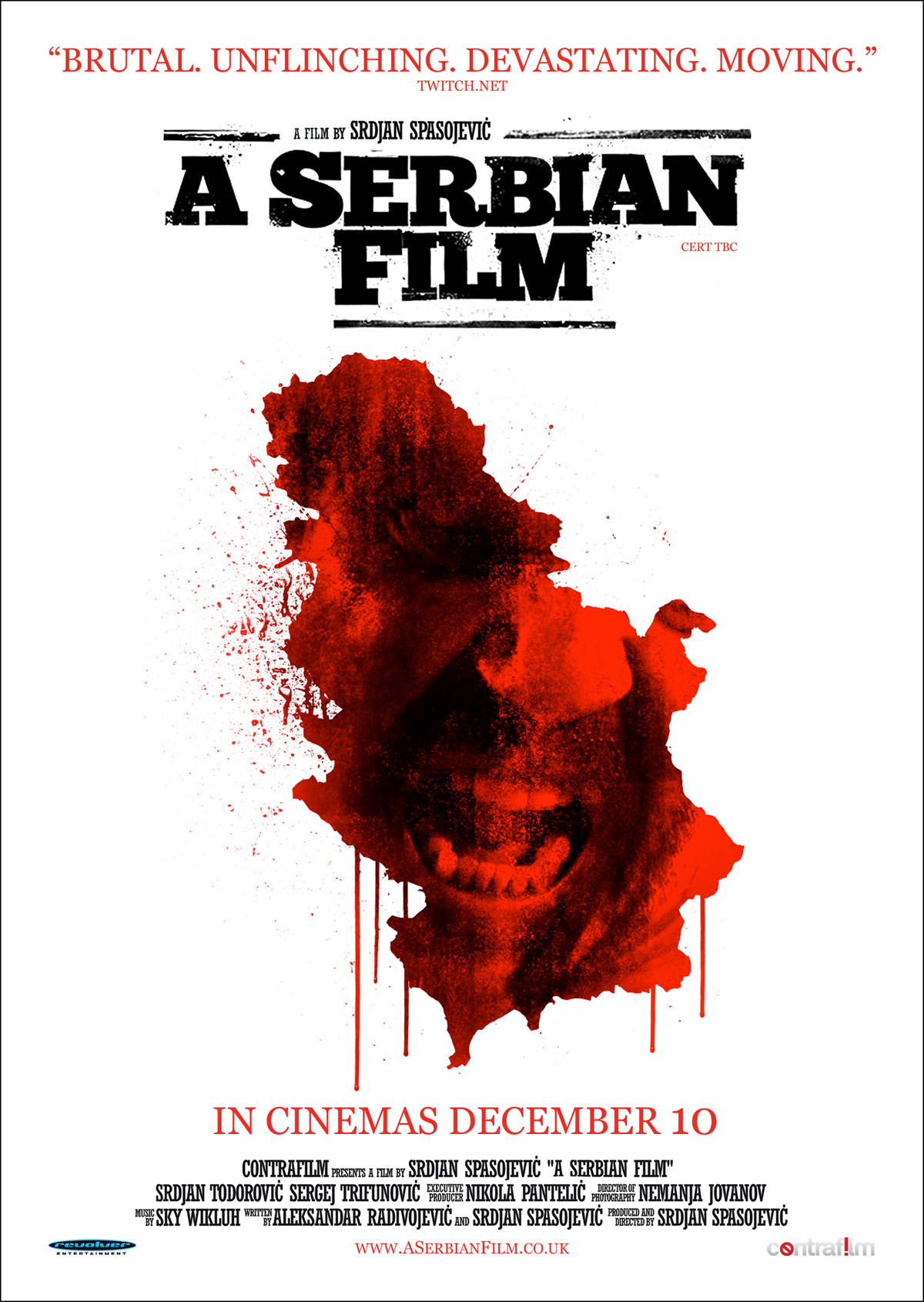
One of the few films in recent years to have been refused an 18 certificate in its uncut form, Sprski Film would be interesting for that fact alone - just as last year's Gurotesuku (Grotesque) was for being rejected in its entirety. But unlike Grotesque - which was nasty, unrelenting torture with no narrative or message - A Serbian Film is a transfixing, astonishing piece of work.
The story follows Milos, a semi-retired porn actor now married with a young son. The opening scene involves this son watching one of his father's movies. (This is not by any means the film's most disturbing scene involving sex and children.) Milos is offered a final job by Vukmir, a filmmaker who wants to make a new type of porn film. The catch is that the artistic process means he's not allowed to see the script in advance; rather, he must explore the possibilities of each setup in real time, ostensibly to heighten the film's realism. However, the real reason Milos isn't shown the script is that Vukmir wants him to perform acts so illegal, immoral and reprehensible that he would never have signed up had he known. But is it too late for Milos to get out of the strictly-enforced contract?
The BBFC report makes interesting reading, but be warned that many of the more shocking scenes are described in such detail that reading it may diminish the power of the film. Having said that, the BBFC have insisted that A Serbian Film be cut by 4 minutes and 12 seconds for its theatrical and home video release so they've done a pretty good job of that themselves. Though, as I've said before, I find the BBFC's decisions thoughtful and reasonable, these decisions are restricted by the guidelines against which they judge films. The current guidelines are such that they
required forty-nine individual cuts, across eleven scenes. A number of cuts were required to remove elements of sexual violence that tend to eroticise or endorse sexual violence. Further cuts were required to scenes in which images of children are intercut with images of adult sexual activity and sexual violence.It seems impossible that these cuts haven't softened the film's horror. In its uncut form, this is one of the most affecting, disturbing movies I've ever seen. Having little interest in supernatural 'scares', I find most horrific the films that plausibly show people battling with the worst of which humanity is capable. That's one of the reasons I tend to defend so-called torture porn. But in A Serbian Film this theme is really ramped up, because it explores the real horror of what we, through our protagonist, are capable of doing - under the right circumstances, with the right kind of nudging. Vukmir is a sociopathic Milgram, twisting and stretching Milos' free will while observing the results with an excited detachment. The results are stylishly grim, and the conclusion both appalling and inevitable.
Wednesday, 8 December 2010
Harry Potter and the Deathly Hallows part 1
David Yates, 2010.
BBFC rating: 12A.

I finished reading the seventh Harry Potter book for the second time a couple of days ago. The first time I read it, I hated the ending, which I thought was a cop-out, a deus ex machina with a sickening and obvious postscript. Either my cynicism has mellowed or I had previously missed something - I think the latter - because I found it much less egregious this time round. Something I appreciated much more was the structure of the story. The first time I read it, it bothered me that so little was achieved within the first two thirds of the story by the trio around which the it revolves - Harry, Ron and Hermione, who are trying to locate and destroy the six horcruxes in which Voldemort has secreted parts of his soul. And the first half of this story is what this latest film adapts, so the action is sporadic, the outlook generally bleak and the achievements few and far between. But that's how projects go in the real world: it's the slog and the thinking, the exasperation and hand-wringing, that subtly creates the conditions required for its completion. And that's what we see in this film. The payoff comes in part 2, which opens next July. No doubt it, like this and all the other movies in the series, will suffer from unconvincing acting. But, like the more recent Potter adaptations, it will have some spectacular scenes of magic, death and bittersweet victory.
Friday, 19 November 2010
Video Nasties: The Definitive Guide
Jake West, 2010. BBFC rating: 18.

The BBFC, which certifies TV and film into age appropriate categories, doesn't have much of an impact on the watching habits of most adults in this country these days. Although it refused Grotesque an 18 certificate last year, anyone with an interest was able to acquire a digital copy with little effort. It also refused certificates to two other films: NF713 and My Daughter's a Cocksucker were rejected for, respectively, eroticising sexual torture and 'being likely to encourage an interest in sexually abusive activity'. Regardless of your views on censorship in general, these reasons are at least thoughtful and serious.
This seems to be the case for most, if not all, the BBFC's recent decisions. Often they exhibit a wry sense of humour, as in this excerpt from their most recent annual report:
The fact that the complaints about Antichrist were made by people who had not even bothered to research the film's content, much less see it, should not come as a surprise to anyone familiar with the moral panic about video nasties in the early 1980s. As Video Nasties explains, the moral panic may have been spurious, ill-informed and hysterical, but the distributors of the films in question didn't help themselves. By rebranding Day of the Woman as I Spit on Your Grave (admittedly evocative, though not of the film's contents), they were appealing to paternalistic politicians along with excitable teens. Mary Whitehouse and The Daily Mail went through the roof and survey statistics were deliberately misinterpreted and put to good use in lies fed to the public and Parliament.
Moralisers and politicians working together behind closed doors soon led to the introduction of the Video Recordings Act, which required the BBFC to certify any video recording before it could be legally distributed, and the director of public prosecutions compiled a list of films thought to breach obscenity laws - the soon-to-be-infamous list of video nasties.
Video Nasties is rare as a documentary that allows those with opposing views to defend themselves. Alongside the talking heads of academics and producers of modern horror movies sit interviews with and clips of contemporaneous footage of those who opposed the video nasties. The director of public prosecutions and the MP who introduced the Act remenisce about and are clearly proud of the roles they played. The forces of good don't need to lie to make the other side look bad; they're perfectly capable of doing that for themselves, and the story speaks for itself.
It's not often I complain about a film being too short, but this documentary is only 70-odd minutes long and it seems a shame they didn't say more about ongoing controversies, a brief mention of the controversy surrounding A Serbian Film aside. (Of which more should be expected soon, as the movie is slated for a theatrical release in December. Expect Christopher Tookey to hit the roof.) Regardless, anyone interested in video nasties should buy this DVD boxset quickly, before the limited run of 5000 sells out. They should also check out the Video Nasty Project.
The documentary ends with the grim prediction that the current lack of online censorship - of youtube and the like - will likely one day seem distant and utopic, and a reminder that the price of freedom is eternal vigilance. All it takes is The Daily Mail to write a couple of stories spuriously linking a horrible crime or manufactured teenage trend to a subset of films for our politicians to blindly grasp for the parchment. Recent reactions to drug policy critics demonstrate that they cannot be trusted to seek evidence or balance before speaking or legislating. Is it too optimistic to predict they'd have a tougher time stamping on creative and expressive freedom in the age of web 2.0? I hope not.
Packaged with another two DVDs featuring trailers for each of the 72 video nasties, along with introductions by academics and filmmakers as well as a series of postcards featuring lurid promotional artwork, Video Nasties is a great coffee table item as well as an essential reference for these era-defining films.
Cross-posted to D-Notice.
The BBFC, which certifies TV and film into age appropriate categories, doesn't have much of an impact on the watching habits of most adults in this country these days. Although it refused Grotesque an 18 certificate last year, anyone with an interest was able to acquire a digital copy with little effort. It also refused certificates to two other films: NF713 and My Daughter's a Cocksucker were rejected for, respectively, eroticising sexual torture and 'being likely to encourage an interest in sexually abusive activity'. Regardless of your views on censorship in general, these reasons are at least thoughtful and serious.
This seems to be the case for most, if not all, the BBFC's recent decisions. Often they exhibit a wry sense of humour, as in this excerpt from their most recent annual report:
Despite the widespread media coverage of our decision to classify Lars von Trier’s Antichrist ‘18’ with no cuts, we only received 10 complaints. The film was described by correspondents as an “abomination”, “pornographic” and “common trash”. All the comments were made in response to the media coverage; none of the complainants had actually seen the film. Indeed, there was some confusion about the actual nature of the film, with some people believing it to be a film about religion or Jesus Christ.Anyone who speaks fluent bureaucratese will see the grin and sneer suppressed beneath this polite choice of words. I highly recommend reading the report in full (pdf) - it's full of this sort of thing, particularly delightful when describing the complaints received from teenagers about decisions to certify games and films at 18, and is in any case a fascinating insight into film classification and censorship.
The fact that the complaints about Antichrist were made by people who had not even bothered to research the film's content, much less see it, should not come as a surprise to anyone familiar with the moral panic about video nasties in the early 1980s. As Video Nasties explains, the moral panic may have been spurious, ill-informed and hysterical, but the distributors of the films in question didn't help themselves. By rebranding Day of the Woman as I Spit on Your Grave (admittedly evocative, though not of the film's contents), they were appealing to paternalistic politicians along with excitable teens. Mary Whitehouse and The Daily Mail went through the roof and survey statistics were deliberately misinterpreted and put to good use in lies fed to the public and Parliament.
Moralisers and politicians working together behind closed doors soon led to the introduction of the Video Recordings Act, which required the BBFC to certify any video recording before it could be legally distributed, and the director of public prosecutions compiled a list of films thought to breach obscenity laws - the soon-to-be-infamous list of video nasties.
Video Nasties is rare as a documentary that allows those with opposing views to defend themselves. Alongside the talking heads of academics and producers of modern horror movies sit interviews with and clips of contemporaneous footage of those who opposed the video nasties. The director of public prosecutions and the MP who introduced the Act remenisce about and are clearly proud of the roles they played. The forces of good don't need to lie to make the other side look bad; they're perfectly capable of doing that for themselves, and the story speaks for itself.
It's not often I complain about a film being too short, but this documentary is only 70-odd minutes long and it seems a shame they didn't say more about ongoing controversies, a brief mention of the controversy surrounding A Serbian Film aside. (Of which more should be expected soon, as the movie is slated for a theatrical release in December. Expect Christopher Tookey to hit the roof.) Regardless, anyone interested in video nasties should buy this DVD boxset quickly, before the limited run of 5000 sells out. They should also check out the Video Nasty Project.
The documentary ends with the grim prediction that the current lack of online censorship - of youtube and the like - will likely one day seem distant and utopic, and a reminder that the price of freedom is eternal vigilance. All it takes is The Daily Mail to write a couple of stories spuriously linking a horrible crime or manufactured teenage trend to a subset of films for our politicians to blindly grasp for the parchment. Recent reactions to drug policy critics demonstrate that they cannot be trusted to seek evidence or balance before speaking or legislating. Is it too optimistic to predict they'd have a tougher time stamping on creative and expressive freedom in the age of web 2.0? I hope not.
Packaged with another two DVDs featuring trailers for each of the 72 video nasties, along with introductions by academics and filmmakers as well as a series of postcards featuring lurid promotional artwork, Video Nasties is a great coffee table item as well as an essential reference for these era-defining films.
Cross-posted to D-Notice.
Monday, 15 November 2010
The Social Network
David Fincher, 2010. BBFC rating: 12A.

I'm sure there are few people who don't know that this film is about the origins and subsequent legal disputes over the ownership of facebook. Mark Zuckerberg created the website at Harvard in 2004, with the financial help of a friend and some creative help (or so this film assumes) unwittingly provided by a trio of upper class jocks. Zuckerberg is played by Jesse Eisenberg, the likeable lead from Zombieland. As such, although he's frequently gauche and occasionally a bit of a tit, 'Zuckerberg' seems largely likeable. It's unclear how similar 'Zuckerberg' is to Zuckerberg. And that's the only downside to a fast-paced, dialogue-heavy movie: I would much have preferred to know that what I was watching was a close approximation to the truth - though, for reasons the postscript explains, that truth is valuable and closely guarded. Facebook is so much a part of most of our lives that its origins are bound to be a subject of curiosity. But, even taken largely as a work of fiction, The Social Network is well worth seeing. It's not a cinematic movie, though, so one to add to the rental list rather than struggling to see it before it leaves the big screen.
I'm sure there are few people who don't know that this film is about the origins and subsequent legal disputes over the ownership of facebook. Mark Zuckerberg created the website at Harvard in 2004, with the financial help of a friend and some creative help (or so this film assumes) unwittingly provided by a trio of upper class jocks. Zuckerberg is played by Jesse Eisenberg, the likeable lead from Zombieland. As such, although he's frequently gauche and occasionally a bit of a tit, 'Zuckerberg' seems largely likeable. It's unclear how similar 'Zuckerberg' is to Zuckerberg. And that's the only downside to a fast-paced, dialogue-heavy movie: I would much have preferred to know that what I was watching was a close approximation to the truth - though, for reasons the postscript explains, that truth is valuable and closely guarded. Facebook is so much a part of most of our lives that its origins are bound to be a subject of curiosity. But, even taken largely as a work of fiction, The Social Network is well worth seeing. It's not a cinematic movie, though, so one to add to the rental list rather than struggling to see it before it leaves the big screen.
Subscribe to:
Posts (Atom)
