Sunday, 2 October 2011

Tinker, Tailor, Soldier, Spy

Tomas Alfredson, 2011
BBFC rating: 15


I would never have looked any further than the title of this film had I not heard the hype, and found out it was directed by Tomas Alfredson (who turned a mediocre pulp novel into a masterpiece with Let the Right One In). It just sounds too silly. But I was bowled over by Alfredson's involvement and the rave reviews it's been receiving, and went for it. I found myself rather disappointed. It has the singular, atmospheric feel and look that Let the Right One In had, albeit here it's miserable, smoky, 1970s London rather than white, harsh Swedish suburbia. Unfortunately - and I realise this is more likely to be my fault than the film's - the plot was very difficult to follow, largely because there were so many characters and so little time in which to learn their names. Which military intelligence bod has sold them out to the Russians? It's very hard to tell when you can't put the hints about characters together because you can't remember which one is which. So while it's not boring, it is confusing, and seems longer than necessary. Or maybe it's just that I just would have preferred to see Tinker, Tailor, Soldier, Vampire.

Wednesday, 21 September 2011

Kill List

Ben Wheatley, 2011
BBFC rating: 18


What makes the difference between a horror movie and a thriller? I think in many cases it's all in the ending. Films about the main players being trapped - like Buried and Frozen - would be thrillers if they culminated in escape and horror films if they didn't. This could depend on as little screen time as the final 15 or so seconds. Thrillers and horror movies often rely largely on tension ratcheted up over the course of the film, giving the audience time to acclimatise to the baseline and get to know and invest in the characters - to magnify either the horror when it arrives, or the sense of vicarious relief when it doesn't. Kill List straddles the thriller/horror boundary, moving across toward the latter as the film progresses. I can understand why it has been described variously as one or the other (and as the ambiguous 'chiller' in the quote on the promo poster above).

Much like Skeletons and The Disappearance of Alice Creed (a similarly brutal and enthralling movie), Kill List centres around the relationship between two male characters. The three also have in common low budgets, stark British landscapes and a melancholic tone as well as convincing acting, intriguing plots and fairly limited cinematic releases. My guess is if you like them, you'll like this too - as long as you don't mind a splash of horror with your thrills and drama.When the horror finally arrives, it's nicely done: jeopardy, chases, and blood and guts are all present, correct and stylish and the horror has overtones of A Serbian Film, The Wicker Man and The Last Exorcism. It's not quite got the conceptual strength to linger for ages in my mind like Martyrs did, for example, but it certainly has the balls and the guts to induce the queasiness and dread the poster promises.

Thursday, 2 June 2011

Senna

Asif Kapadia, 2010
BBFC rating: 12A


Documentaries examining motorsports, including their attendant tragedies, are popular this year, with Closer to the Edge still in cinemas as Senna is released. Sadly, this year's Isle of Man TT has already seem fatal accidents with a sidecar partnership both killed in practice earlier this week. Motorcycle racing is not the only dangerous sometime-road-based sport around, however. Last weekend's Monte Carlo grand prix gave us viewers a timely reminder that driving open-wheel sports cars round tight circuits at 200mph can be dangerous too. Sergio Perez's crash in the third qualifying session saw the first time since Felipe Massa's Hungaroring incident in 2009 that a driver remained in the car for minutes after coming to a stop with injuries of unknown severity - a tense scenario which fortunately had a happy ending on Saturday, as did Vitaly Petrov's less spectacular but still potentially nasty crash in the following day's race.

In fact anyone who pays any attention to Formula 1 will already know that Ayrton Senna, the Brazilian three-time champion, was the last driver to be killed in an F1 crash. Fewer people are likely to be aware of the internal politics and the macabre aura over that race weekend, and no-one had seen until this film the footage of Senna's backroom srguments with FIA bosses during pre-race driver's meetings, in which he pleaded for changes to be made to tracks to improve safety. In the post-screening Q&A at the preview I attended, the director said he saw footage of Senna criticising the specific corner on which his fatal accident later took place. However, he decided not to include that in the film - given the number of track features Senna remarked upon during his time in racing, he thought cherry-picking that footage would have added drama at the expense of authenticity.

I thought that was very admirable. And Senna is definitely authentic. The visuals are stitched together entirely from footage of Senna and, although there's the occasional snippet of interview voiceover to set context or explain what we're seeing, the story largely tells itself. The combination of previously unseen backstage footage and clips of classic F1 races on the big screen was for me entirely compelling. I thought the fact I found it hard to imagine anyone having a different reaction might just be down to my lack of imagination but surely not every reviewer who contributed to its 100% Rotten Tomatoes rating can also be a motorsport geek. In fact, even sport-hater Mark Kermode commended it on his 5Live show. Recommendations don't come much better than that.

Sunday, 22 May 2011

Closer to the Edge

a.k.a. TT3D

Richard de Aragues, 2011


A couple of months ago the BBC broadcast a documentary about 'the killer years' of Formula 1 (here's a link to the first part on youtube). It documents how, in the 1960s and 70s, drivers were frequently killed in racing incidents. Their cars were fast but flimsy, easily breaking into pieces - which could then fly into the cockpit - or bursting into flames. The tracks were lined with trees and walls - rather than gravel run-off for a more gentle stop - and haybales, leading to spectacular inflagrations. The drivers lacked the fireproof suits and head-and-neck-support systems which nowadays prevent them from burning alive and snapping their spines respectively. F1 now has far fewer sickening moments and even fewer serious injuries. No-one's died in a crash since 1994, the year Ayrton Senna - the subject of a documentary opening on 3 June - was killed in San Marino.

The same cannot be said for motorcycle racing. Its competitors are prone to being flung from their vehicles - occasionally into the path of their competitors - and lack a surrounding chassis to absorb impact energy. Most  track motorcycle races are, however, held on circuits with similar safety features to those used in F1: Armco crash barriers, tyre walls, long run-off areas at corners. No such luxuries for those who race for the Isle of Man tourist trophies every June, though. This circuit round the roads of the island is lined with the features of everyday driving - houses, walls, lampposts - but the top racers average 130mph round the circuit, hitting 200 plus on the straights.

Shot in the lead up to the 2010 Isle of Man racing festival, the movie culminates with tense footage from the five main races of the weekend. The hero of sorts is Guy Martin, a straight-talking northern mechanic who loves fixing lorries, masturbating and, most of all, racing motorbikes. He's like a two-wheeled Karl Pilkington (a thought I was dismayed to discover wasn't an original one), with probably more self-awareness than he lets on but plenty of charisma and casual confidence in his singular worldview. Before 2010, he's had podium (top three) finishes in several TTs but hasn't won one - he's determined to put that right this year.

Since I had no idea what happened at the 2010 TT before I went to see this film, I found it as exciting and suspenseful as watching the action live would be. I'd strongly recommend anyone thinking of seeing it to do so without researching the results beforehand. Guy Martin is not the only rider the film-makers interviewed; there are many others, and the tension comes not only from wondering whether the riders you've met will win, but whether they'll survive - intact or otherwise. It's not giving much away to say that one or two of the later interviews' subjects are filmed talking from their hospital beds.

Closer to the Edge has a perfectly-balanced combination of race footage, backstage events and personal stories. Run by enthusiasts, populated by amateur riders and providing nail-biting thrills for spectators, the TT was so well showcased by this film that I'm now wondering how best to make it over to watch next year's in person.

Thursday, 31 March 2011

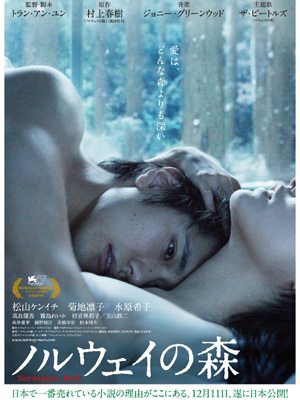
Noruwei no mori

a.k.a. Norwegian Wood

Tran Anh Hung, 2010. BBFC rating: 15.


Being a teenager is rubbish. This film gets that right - though really these kids should, by the age they've reached (which seems to be about 19), have at least begun to grow out of the stage of sulking and sobbing. On the contrary, however, the kids in Norwegian Wood spend their time moping, crying, walking melancholically around fields, killing themselves, and having awkward, miserable sex. Sometimes they combine these activities. 

And they're the lucky ones. At least adolescent angst is interesting to the angstee: what's in it for the audience? Well, we get some pretty cinematography. But that's about it. There's the occasional laugh, no doubt unintended by the director, as when our hero stands on a cliff screaming at the sky to the backing of a screeching orchestra. (Yes, really.) The score is awful - grating, hammy, and distracting. Apparently it was put together by Jonny Greenwood off of Radiohead, which makes it rather a fall from grace for him.

Mind you, the film is actually rather reminiscent in tone of early Radiohead. Take "Street Spirit" with its adolescent, portentous and surely in retrospect embarrassing lyrics ("cracked eggs, dead birds, scream as they fight for life": 'cause if you're 14, you know that life's really all about death), which is tonally similar to this. There are two major differences, however. First, "Street Spirit" is shimmering and evocative, unlike either the music or the narrative of Norwegian Wood. And, more importantly, it lasts just over four minutes. Norwegian Wood lasts over thirty times that long. Avoid.

Monday, 28 February 2011

Never Let Me Go / Splice / Legion

I have seen a couple of newish films recently so I'll quickly share my views on them.

First up is Never Let Me Go, the adaptation of Kazuo Ishiguro's 2005 novel of the same name. The novel is pretty much perfect - allowing the reader a glimpse of an other (but not very other) world through the eyes of a character immersed in a small part of it. She gets only small clues, the significance of which she rarely understand, and it's left to the reader to infer the science behind the fiction. Unfortunately the film is a little more explicit about that than the novel - some things that should be left to the viewer to infer are presented directly instead - though not to the extent that it spoils what is an excellent adaptation. Like the book, the movie is all about its three main characters and their love triangle. And I was relieved to find that the song after which the book is named is up to the job it has in the film.

Splice, which I missed at the cinema and caught recently on bluray, is altogether different. Science in this is a case of throwing lots of exciting data and cells and swirling nucleotides around, mixing them all up, and seeing what happens. It's as close to the reality of genetic engineering as Hackers was to the reality of bypassing network security. It's really nicely shot - lots of great low angle shots of labs and shacks - and it has a good monster (secretly created by the rockstar science bods in an act of rebellion when their boss asks them instead to make boring proteins all day). Fun, but very silly.

Not as silly as Legion, mind you, which I just watched on bluray. This is The Terminator meets From Dusk til Dawn meets the nativity story. Except even more portentous and absurd than that sounds. Still, again, it's pretty good fun.

Sunday, 6 February 2011

Black Swan

Darren Aronofsky, 2010.
BBFC rating: 15.


There's a book by called The Black Swan about 'the impact of the highly improbable'. It may be full of interesting facts and astute analysis, but I will never know because the first few pages, which are all I managed, are such an absurdly over-written, insufferably smug, self-congratulatory wankfest that I threw the book into the bin lest some other unfortunate soul should find it and suffer the same blood-boiling rage that I did. This has nothing to do with Black Swan, a far superior piece of work; I am simply providing a public service by warning you off its awful titular twin.

Black Swan tells the story of Natalie Portman's obsessive, uptight ballet dancer and her struggle to embody the dark side of her Swan Lake character. It has a fairly straightforward horror movie narrative: we are introduced to the characters and follow them around for half an hour or so before the occasional strange happenings multiply and intensify, accelerating us towards the inevitable conclusion. Though clearly belonging in the psychological horror category, Black Swan was featured on the cover of high-end coffee table film mag Little White Lies as well as grindhouse periodical Fangoria: it has transcended the genre, such that several unsuspecting souls have found themselves traumatised at the end of a film they anticipated would be a nice family ballet movie. It's not. But, while its sticking to horror convention makes its plot predictable - as with many such movies (including Heartless, of which it rather reminded me) - that is no bad thing. It is, of course, all about the journey - which is well worth making.