Showing posts with label movie review. Show all posts

Friday, 9 September 2016

David Brent: Life on the Road

Ricky Gervais, 2016

Life is a boring burden. Shouldering it is relieved only occasionally and fleetingly by a moment of meaning. You can't create these moments for yourself; they arrive only by chance or through others' acts of mercy.

This vision of existence depicted in Life on the Road doesn't differ much from the vision in The Office. But now that David Brent is a decade adrift from the social structure of Wernham Hogg, he can no longer rely on his colleagues' occasional sympathetic participation in these life-affirming encounters.

Unfortunately this means no more Tim Canterbury, one of few characters with insight in The Office, whose functions included interpreting events for the viewer in the show's characteristic head-shot monologues. Instead Brent has to supply the philosophy himself. That would be fine if he hadn't also descended further into the depths of ham-fisted cluelessness: the film sees him renting session musicians to join him on a 'tour' of various jam nights and crap pub gigs in and around Slough, all the while waffling about bagging a major label contract. So when he shifts into Werner Herzog mode, it's a bit jarring. As are the occasional moments that deliberately reference popular jokes from the TV series. Life on the Road is still a mock-doc, and anything that pulls the viewer out of that is a moment of failure.

Having said all that, Life on the Road does have some great jokes, scenes of redemption, and an open ending that suggests that Brent might finally make peace with his place in the world and begin to build a happier life around it.

But that's also a problem, for this prospect seems hollow when you recall the structurally similar epiphanies and possibilites at the end of The Office's Christmas episodes. They really should had been the end of the David Brent story. This film, well-made, poignant and enjoyable as it is, sullies the ending of the TV series, presenting a bleaker vision of Brent's future. It may be capturing the zeitgeist, but it left me with a heavy heart.

Friday, 21 October 2011

Drive

Nicolas Winding Refn, 2011
BBFC rating: 18


Like Taxi Driver, which is clearly a source of inspiration for this movie, Drive follows a man of quiet violence motoring around the streets, resolutely following his own unusual moral code, unaccountably putting all his eggs into the basket of a woman he barely knows but with whom he has a relationship of semirequited love. Gosling's unnamed character is like a cross between Travis Bickle and Ryan from The O.C., handsomely prowling Los Angeles in his heavy boots and gold bubble jacket. His journey is filmed in strikingly framed shots with artificial lighting (apparently) from mundane sources - strip lights, indoor lamps - that somehow manages to look mystical, transcendental at times. There are scenes of brutal, up-close violence which Mark Kermode likened to scenes from Gaspar Noé movies: certainly they bear some resemblance to the early death-by-fire-extinguisher section of Irreversible or the repeated car crash and aftermath segments of Enter the Void. But where Noé keeps the camera directly on the action, Refn's shots are briefer and more oblique. In other words, Drive is nowhere near as difficult to watch as the Noé comparison would suggest.

Having recently spent time driving in and around LA, I found the landscape gave me the excitement of vague familiarity and, frankly, I would have been happy just watching the scenes shot from our hero's bucket seat for minutes at a time. Fortunately for everyone else, none of these sections last long except in the less prosaic sequences where Gosling races and hides from the pursuing police like a naughty kitten intent on staying out after dark. The action builds, swells and breaks with a natural rhythm over the course of its 100 minutes, as its characters cross and backstab each other while the stakes rise along with the body count.

The only minor problem with Drive is that it's shot digitally, which means it suffers from the same distracting pixellation artefacts as other digital films. Of course that won't matter for the home video market (unless you've got a 15-foot tellly). But this was the only negative thing I could think of about Drive. It's The Fast and the Furious with guts, balls and acting; Taxi Driver plus Death Proof plus tension. Unmissable.

Picture credit: Pierrot Neron. Picture appropriated from the facebook fan page, which includes other such posters designed by the general public.

Thursday, 2 June 2011

Senna

Asif Kapadia, 2010
BBFC rating: 12A


Documentaries examining motorsports, including their attendant tragedies, are popular this year, with Closer to the Edge still in cinemas as Senna is released. Sadly, this year's Isle of Man TT has already seem fatal accidents with a sidecar partnership both killed in practice earlier this week. Motorcycle racing is not the only dangerous sometime-road-based sport around, however. Last weekend's Monte Carlo grand prix gave us viewers a timely reminder that driving open-wheel sports cars round tight circuits at 200mph can be dangerous too. Sergio Perez's crash in the third qualifying session saw the first time since Felipe Massa's Hungaroring incident in 2009 that a driver remained in the car for minutes after coming to a stop with injuries of unknown severity - a tense scenario which fortunately had a happy ending on Saturday, as did Vitaly Petrov's less spectacular but still potentially nasty crash in the following day's race.

In fact anyone who pays any attention to Formula 1 will already know that Ayrton Senna, the Brazilian three-time champion, was the last driver to be killed in an F1 crash. Fewer people are likely to be aware of the internal politics and the macabre aura over that race weekend, and no-one had seen until this film the footage of Senna's backroom srguments with FIA bosses during pre-race driver's meetings, in which he pleaded for changes to be made to tracks to improve safety. In the post-screening Q&A at the preview I attended, the director said he saw footage of Senna criticising the specific corner on which his fatal accident later took place. However, he decided not to include that in the film - given the number of track features Senna remarked upon during his time in racing, he thought cherry-picking that footage would have added drama at the expense of authenticity.

I thought that was very admirable. And Senna is definitely authentic. The visuals are stitched together entirely from footage of Senna and, although there's the occasional snippet of interview voiceover to set context or explain what we're seeing, the story largely tells itself. The combination of previously unseen backstage footage and clips of classic F1 races on the big screen was for me entirely compelling. I thought the fact I found it hard to imagine anyone having a different reaction might just be down to my lack of imagination but surely not every reviewer who contributed to its 100% Rotten Tomatoes rating can also be a motorsport geek. In fact, even sport-hater Mark Kermode commended it on his 5Live show. Recommendations don't come much better than that.

Sunday, 22 May 2011

Closer to the Edge

a.k.a. TT3D

Richard de Aragues, 2011


A couple of months ago the BBC broadcast a documentary about 'the killer years' of Formula 1 (here's a link to the first part on youtube). It documents how, in the 1960s and 70s, drivers were frequently killed in racing incidents. Their cars were fast but flimsy, easily breaking into pieces - which could then fly into the cockpit - or bursting into flames. The tracks were lined with trees and walls - rather than gravel run-off for a more gentle stop - and haybales, leading to spectacular inflagrations. The drivers lacked the fireproof suits and head-and-neck-support systems which nowadays prevent them from burning alive and snapping their spines respectively. F1 now has far fewer sickening moments and even fewer serious injuries. No-one's died in a crash since 1994, the year Ayrton Senna - the subject of a documentary opening on 3 June - was killed in San Marino.

The same cannot be said for motorcycle racing. Its competitors are prone to being flung from their vehicles - occasionally into the path of their competitors - and lack a surrounding chassis to absorb impact energy. Most  track motorcycle races are, however, held on circuits with similar safety features to those used in F1: Armco crash barriers, tyre walls, long run-off areas at corners. No such luxuries for those who race for the Isle of Man tourist trophies every June, though. This circuit round the roads of the island is lined with the features of everyday driving - houses, walls, lampposts - but the top racers average 130mph round the circuit, hitting 200 plus on the straights.

Shot in the lead up to the 2010 Isle of Man racing festival, the movie culminates with tense footage from the five main races of the weekend. The hero of sorts is Guy Martin, a straight-talking northern mechanic who loves fixing lorries, masturbating and, most of all, racing motorbikes. He's like a two-wheeled Karl Pilkington (a thought I was dismayed to discover wasn't an original one), with probably more self-awareness than he lets on but plenty of charisma and casual confidence in his singular worldview. Before 2010, he's had podium (top three) finishes in several TTs but hasn't won one - he's determined to put that right this year.

Since I had no idea what happened at the 2010 TT before I went to see this film, I found it as exciting and suspenseful as watching the action live would be. I'd strongly recommend anyone thinking of seeing it to do so without researching the results beforehand. Guy Martin is not the only rider the film-makers interviewed; there are many others, and the tension comes not only from wondering whether the riders you've met will win, but whether they'll survive - intact or otherwise. It's not giving much away to say that one or two of the later interviews' subjects are filmed talking from their hospital beds.

Closer to the Edge has a perfectly-balanced combination of race footage, backstage events and personal stories. Run by enthusiasts, populated by amateur riders and providing nail-biting thrills for spectators, the TT was so well showcased by this film that I'm now wondering how best to make it over to watch next year's in person.

Thursday, 31 March 2011

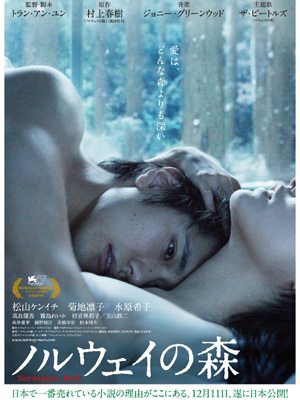
Noruwei no mori

a.k.a. Norwegian Wood

Tran Anh Hung, 2010. BBFC rating: 15.


Being a teenager is rubbish. This film gets that right - though really these kids should, by the age they've reached (which seems to be about 19), have at least begun to grow out of the stage of sulking and sobbing. On the contrary, however, the kids in Norwegian Wood spend their time moping, crying, walking melancholically around fields, killing themselves, and having awkward, miserable sex. Sometimes they combine these activities. 

And they're the lucky ones. At least adolescent angst is interesting to the angstee: what's in it for the audience? Well, we get some pretty cinematography. But that's about it. There's the occasional laugh, no doubt unintended by the director, as when our hero stands on a cliff screaming at the sky to the backing of a screeching orchestra. (Yes, really.) The score is awful - grating, hammy, and distracting. Apparently it was put together by Jonny Greenwood off of Radiohead, which makes it rather a fall from grace for him.

Mind you, the film is actually rather reminiscent in tone of early Radiohead. Take "Street Spirit" with its adolescent, portentous and surely in retrospect embarrassing lyrics ("cracked eggs, dead birds, scream as they fight for life": 'cause if you're 14, you know that life's really all about death), which is tonally similar to this. There are two major differences, however. First, "Street Spirit" is shimmering and evocative, unlike either the music or the narrative of Norwegian Wood. And, more importantly, it lasts just over four minutes. Norwegian Wood lasts over thirty times that long. Avoid.

Saturday, 29 January 2011

127 Hours

Danny Boyle, 2010
BBFC rating: 15


Self-surgery is quite an ordeal for someone with the training, skills and equipment to carry it out - as recorded in this case report of a surgeon who, stuck in the Antarctic and faced with death as the alternative, removed his own appendix. Included are extracts from the surgeon's diary:
An oppressive feeling of foreboding hangs over me ... This is it ... I have to think through the only possible way out: to operate on myself ... It’s almost impossible ... but I can’t just fold my arms and give up...
I didn’t permit myself to think about anything other than the task at hand. It was necessary to steel myself, steel myself firmly and grit my teeth...
I grow weaker and weaker, my head starts to spin. Every 4-5 minutes I rest for 20-25 seconds. Finally, here it is, the cursed appendage! With horror I notice the dark stain at its base. That means just a day longer and it would have burst...
But even this looks controlled and safe compared to the 'operation' Aron Ralston carried out on himself five days after his arm became trapped under a huge boulder down a crevice in the middle of a desert. He had to deliberately break both bones in his forearm before cutting through the muscle, blood vessels, tendons, nerves and probably various other tissues that would be very painful to snip using a blunt penknife. 127 Hours, as its title implies, tells the story of what happened over that period. Now the story above might make you wince in sympathetic agony, imagining the horror of being faced with the choice between that and death yourself. Or you might agree with Michael Legge (I usually do; his blog is brilliant, the best written by a comedian that I know of) who has a less sympathetic take on the scenario:
The whole way through the film your head can't help shouting "YOU STUPID FUCKING PRICK" constantly. Who the fuck does these things? Who invented extreme sports? Why is smashing yourself to bits thought of as a rush? Isn't Batman on the Wii enough? 127 Hours is a true story about a man who likes going into the middle of the desert, WHERE NO ONE CAN FIND HIM, and climbing deep down into tiny crevaces hundreds of feet into the rock. WHAT A CUNT. I hate him. When he falls, traps his arm and spends six days going insane until he cuts his own arm off, it was all I could do to stop myself standing up and shouting "THERE YOU GO, YOUNG MAN. YOU DESERVED THAT..."
I can see his point.

As Ralston waits to die - slim chances of rescue slipping away - he remenisces about an ex-girlfriend, played by Clémence Poésy (seen recently in Harry Potter and Heartless), whose presence would brighten any film. Like The King's Speech, this is a true story so its narrative and conclusion are unlikely to surprise anyone. The only mystery is how Boyle is going to make it interesting. Which he does, with brass knobs on. It's certainly more interesting than reading interviews with Ralston himself, who seems to largely blather on about fate and Gaia and spirituality and other such drivel. 127 Hours is totally gripping, in part because of the memory sequences and the hallucinatory sections (which play out much like the cold turkey scenes in Boyle's Trainspotting). But it's also remarkable just how enthralling the footage of a man stuck under a rock manages to be. 

Sunday, 19 December 2010

Luftslottet som sprängdes

a.k.a.
The Girl who Kicked the Hornet's Nest

Daniel Alfredson, 2009. 
BBFC rating: 15.


Like Harry Potter and the Deathly Hallows, this is an adaptation of final part of a much-loved series of novels. It starts immediately where its predecessor finished, Lisbeth being airlifted from the scene of her attempted murder of her father, defected Soviet spy Alexander Zalachenko. Shortly afterwards, while she is still recovering in hospital from her cranial gunshot wound, the police attempt to interview and then charge her for this crime. Meanwhile, a secretive sub-section of the security police is at work trying to prevent the exposure of their conspiracy to protect the abusive, conscience-free Zalachenko - by whatever means necessary. Mikael and Millenium (the magazine he edits) also become targets when it transpires they intend to publish an expose of this conspiracy in the run-up to Lisbeth's trial. Things are further complicated by the fact that Lisbeth's brother - enormous, sociopathic and congenitally immune to pain - is on the loose. The Girl Who Kicked the Hornet's Nest is not the best of the Millenium trilogy, in my opinion - the narrative requires a lot of setup before the action can begin properly, and it doesn't feel as self-contained as the first two in the series. But, like its source novel, it's a satisfying conclusion to the series.

Saturday, 11 December 2010

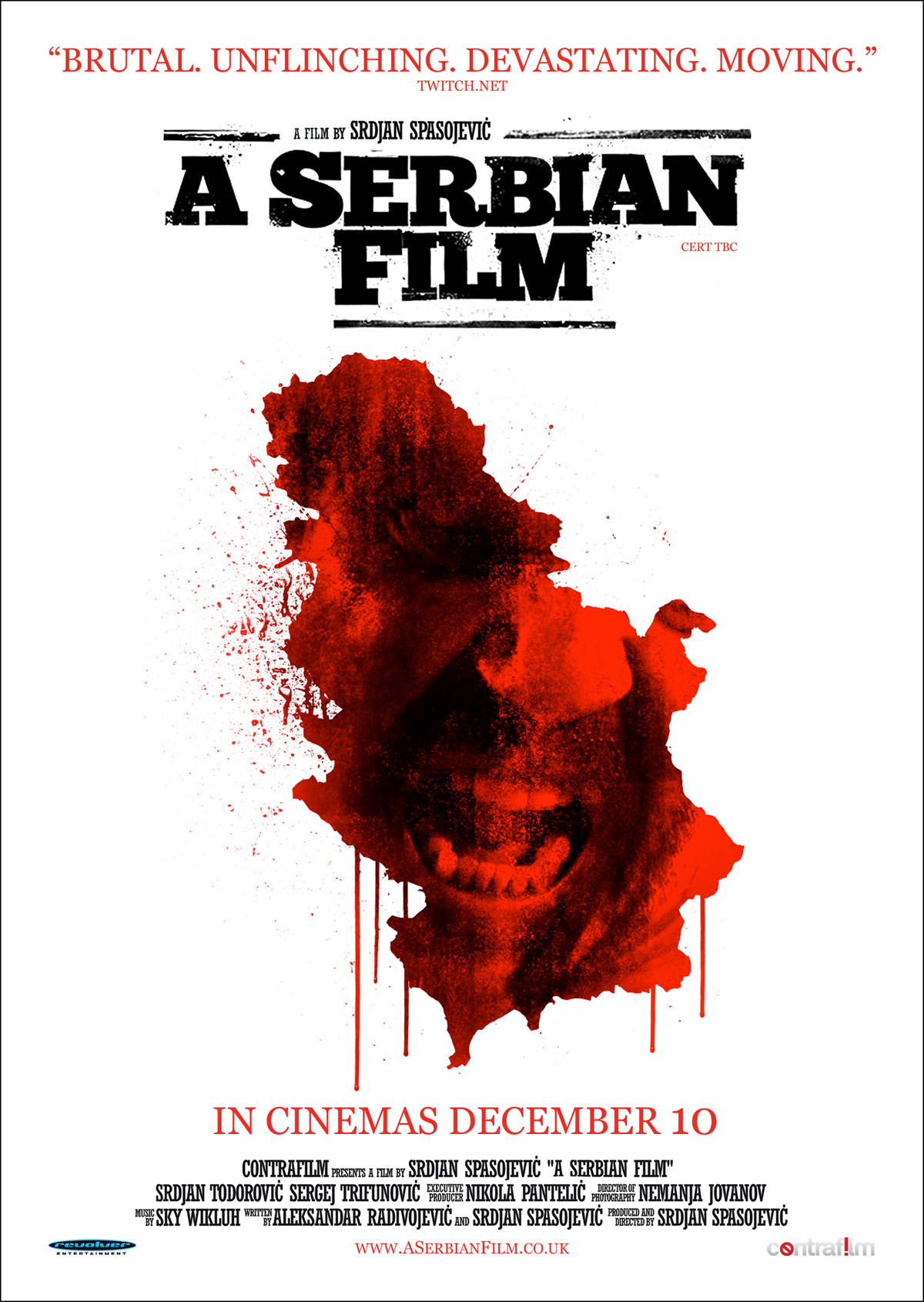
Srpski Film

a.k.a.
A Serbian Film

Srdan Spasojevic, 2010.
BBFC rating: 18 (with compulsory cuts)


One of the few films in recent years to have been refused an 18 certificate in its uncut form, Sprski Film would be interesting for that fact alone - just as last year's Gurotesuku (Grotesque) was for being rejected in its entirety. But unlike Grotesque - which was nasty, unrelenting torture with no narrative or message - A Serbian Film is a transfixing, astonishing piece of work.

The story follows Milos, a semi-retired porn actor now married with a young son. The opening scene involves this son watching one of his father's movies. (This is not by any means the film's most disturbing scene involving sex and children.) Milos is offered a final job by Vukmir, a filmmaker who wants to make a new type of porn film. The catch is that the artistic process means he's not allowed to see the script in advance; rather, he must explore the possibilities of each setup in real time, ostensibly to heighten the film's realism. However, the real reason Milos isn't shown the script is that Vukmir wants him to perform acts so illegal, immoral and reprehensible that he would never have signed up had he known. But is it too late for Milos to get out of the strictly-enforced contract?

The BBFC report makes interesting reading, but be warned that many of the more shocking scenes are described in such detail that reading it may diminish the power of the film. Having said that, the BBFC have insisted that A Serbian Film be cut by 4 minutes and 12 seconds for its theatrical and home video release so they've done a pretty good job of that themselves. Though, as I've said before, I find the BBFC's decisions thoughtful and reasonable, these decisions are restricted by the guidelines against which they judge films. The current guidelines are such that they
required forty-nine individual cuts, across eleven scenes. A number of cuts were required to remove elements of sexual violence that tend to eroticise or endorse sexual violence. Further cuts were required to scenes in which images of children are intercut with images of adult sexual activity and sexual violence.
It seems impossible that these cuts haven't softened the film's horror. In its uncut form, this is one of the most affecting, disturbing movies I've ever seen. Having little interest in supernatural 'scares', I find most horrific the films that plausibly show people battling with the worst of which humanity is capable. That's one of the reasons I tend to defend so-called torture porn. But in A Serbian Film this theme is really ramped up, because it explores the real horror of what we, through our protagonist, are capable of doing - under the right circumstances, with the right kind of nudging. Vukmir is a sociopathic Milgram, twisting and stretching Milos' free will while observing the results with an excited detachment. The results are stylishly grim, and the conclusion both appalling and inevitable.

Monday, 15 November 2010

The Social Network

David Fincher, 2010. BBFC rating: 12A.


I'm sure there are few people who don't know that this film is about the origins and subsequent legal disputes over the ownership of facebook. Mark Zuckerberg created the website at Harvard in 2004, with the financial help of a friend and some creative help (or so this film assumes) unwittingly provided by a trio of upper class jocks. Zuckerberg is played by Jesse Eisenberg, the likeable lead from Zombieland. As such, although he's frequently gauche and occasionally a bit of a tit, 'Zuckerberg' seems largely likeable. It's unclear how similar 'Zuckerberg' is to Zuckerberg. And that's the only downside to a fast-paced, dialogue-heavy movie: I would much have preferred to know that what I was watching was a close approximation to the truth - though, for reasons the postscript explains, that truth is valuable and closely guarded. Facebook is so much a part of most of our lives that its origins are bound to be a subject of curiosity. But, even taken largely as a work of fiction, The Social Network is well worth seeing. It's not a cinematic movie, though, so one to add to the rental list rather than struggling to see it before it leaves the big screen.

Heartless

Philip Ridley, 2010. BBFC rating: 18.


I hadn't realised when watching it on bluray recently that Heartless only came out this year - a British horror film that, like Salvage, had a home video release date only days after its theatrical release. It's set, from what I could tell, around London's Commercial Street and the backroads of Bethnal Green (quiet streets meandering around and under railway arches) and lit in a tungsten orange that works so much better than the same colour scheme does in Let Me In

Jamie is a 25 year old photographer who seems to work in a family firm. He lives with his mother and reveres his late father, also a photographer, who's played by Timothy Spall. In looks and in some respects in character, he's like an older, less confident Donnie Darko. That lack of confidence he attributes to the large heart-shaped birthmark on his face. His home streets of east London are plagued with violent gangs of hooded and masked young men - a not dissimilar world from that portrayed in last year's utterly depressing Harry Brown - according to the media. But Jamie knows better - these are not humans, but demons. And extremely effective, chilling demon faces they have too - these are not the friendly or stupid monsters of Buffy and the like.

I'd suggest watching it without knowing too much of what comes next, but suffice it to say Jamie is led into extreme darkness, seduced by its opportunities and attempting to dodge complicity. He also sees a chance to obtain love and happiness with Tia, an aspiring model played by Clémence Poésy (who was Fleur Delacour in the fourth Harry Potter film). But this is a horror movie, not a romance. It explores good and evil, free will and its absence, the visual nature of beauty, and the despair of being powerless. And if that makes it sound like a load of pretentious old tosh, don't worry - it isn't.

Heartless has not, however, been universally revered. The reviews on Rotten Tomatoes demonstrate the fairly extreme divide between those who loved it and those who didn't. Even Ben Austwick, with whom I normally agree entirely, slates it. I can't say I understand the negative coverage it received, but I can tell you that it reminded me of films and books I love, and maybe that'll go some way to suggesting its appeal. As well as Harry Brown  and Donnie Darko, Heartless strongly put me in mind of Irvine Welsh's experimental novel Marabou Stork Nightmares and this year's British indie movie Skeletons. It evokes some of the visceral dread conjured by the likes of Antichrist and A Serbian Film. And it has the sad beauty of the tender moments in a Gaspar Noé movie - the siblings playing together in Enter the Void, or Monica Belluci reading in the sunshine at the end of Irréversible.

And the thing that really sold me on Heartless: it's a film that has devils and demons alongside guns and gangsters, and pulls it off without selling either aspect short. Daniel Stamm and Eli Roth, take note - here's how to make a realist film with supernatural elements that doesn't alienate its audience. I really can't say enough good things about Heartless. It must be one of the five or six best films of the year. If you live in the UK, rent it. If you live in the States, you're in luck - it premieres there tomorrow.

Saturday, 13 November 2010

Let Me In

Matt Reeves, 2010. BBFC rating: 15.


I've been both excited about and dreading Let Me In, the English-language remake of Swedish vampire movie Let the Right One In, that modern classic which I loved and which real critics - as well as I - thought was the best film of 2009.

The story is the same. A bullied and lonely 12-year-old boy - called Owen rather than Oskar in this version - befriends an odd local child, apparently a girl of the same age, though as a vampire neither her sex nor her age are quite what they seem. They slowly grow fond of each other, though Abby's time in Owen's neighbourhood is limited: her necessity for blood means she and her cohabitee, an older man with whom she has a complex relationship, leave a trail.

The first thing that really struck me about Let Me In was the colour. Where Let the Right One In is shot in brilliant white light, Let Me In glows faintly orange. It's the same as the difference between the tungsten and flourescent settings on a camera's white balance. And one of the things that made Let the Right One In so special for me was its visuals, the contrast between the pure white snow and the occasional flashes of colour when ruby red blood drips onto it, or a rubix cube is foregrounded against it. This contrast is lost in the remake.

There are other problems, for me, with this new version. Abby - though well played by Chloë Moretz, who was Hit Girl in Kick-Assseems slightly too old, when compared to Eli, and she also lacks Eli's other-wordly qualities. Many of the key scenes are very similar to, but never better than, the original. The audience is spoon-fed the story and the nature of the vampire's life is revealed in ways that were only hinted at in the stark, fill-in-the-blanks narrative of the original. Similarly, the soundtrack gives the audience a bit too much, and is a little irritating at times - though it works well in the tense and dramatic scenes, it feels intrusive in the slower, quiter scenes.

Although I'm comparing it entirely negatively with the original, Let Me in isn't a bad film - considered on its own it's a very good film indeed, though it's hard to know how the experience would differ for someone who had not seen the original - but it's simply superfluous. There'd be no point owning this inferior remake because when it came to rewatching, you'd pick Let the Right One In every time.

Saturday, 23 October 2010

Mr Nice

Bernard Rose, 2010. BBFC rating: 18.


Quite the reverse of Made in Dagenham, Mr Nice inspired in me nostalgia for the 60s and 70s. Apparently, back then, drug dealers were cheeky chappies gallavanting about the world making everyone stoned and happy. It's a biopic about Howard Marks, the notorious cannabis smuggler, based on his 1996 book of the same name. And the portrayal of trafficking in Mr Nice is about as far from that in The Wire as you can get. This is closer to the jolly larks of Just William.

The film follows Marks from his sixth form in rural Wales, through undergraduate study at Oxford, to his business travels from Pakistan to California via Northern Irish farmhouses - and, inevitably, to jail. It's odd in the early part of the movie seeing Rhys Ifans, a man clearly in his forties, being patronised by his parents and his 20-years-younger peers. But as Marks leaves Oxford, starts teaching and accidentally falls into being a smuggler (and a part-time spy), the disparity melts away and Ifans is so convincing that I soon forgot Marks wasn't playing himself.

Marks' wife Judy is played by Chloë Sevigny - last seen in Werner Herzog's surreal soap opera My son, My son, what have ye done? only a few weeks back - who is as alluring and subtle as ever in this, moving from coquettish hippie to homely mother without becoming another character entirely. Partly this is because she is always, clearly, in love with Howard: something demonstrated on screen by gooey eyes as well as various restrained sex scenes.

Given this lack of anything sexually explicit, or much violence, I was curious about why the film had been given an 18 rating. Visiting the BBFC classification decision, I was surprised to find that reason was simply the fact that everyone is constantly smoking and talking about weed - the film thus requiring "an adult understanding of the complex moral and social issues surrounding soft drug use". In other words, it makes being a stoner look like a lot of fun. The rating most likely demonstrates the BBFC's knowledge that parents, believing their teenagers to be naive but suggestible, don't want them being encouraged to skin up. Of course, any teen stoner can pick up the book on which Mr Nice is based. I read it at 15 or 16 and I'm pretty sure it made me want to be an international drug smuggler, an ambition I fortunately failed to pursue.

Oh, the BBFC decision does note that we are also treated to the "brief sight of the head of a man’s penis after he has drawn a face on it". That'll be Jim McCann, then: the crazy, drunken, stoned, gun-toting, whoring but kind of lovable pal of Marks' who helps him channel drugs via Ireland (his IRA pals letting tons of hash through customs in the belief they're "importing guns for the cause"). Fotunately the movie manages to portray McCann and other quirky characters without turning them into Guy Ritchie caricatures.

I quite enjoyed Mr Nice. It comprises a series of well-acted, amusing set pieces but because I've read the source material, I was able to fill in the gaps - such as most of his time in prison, and the ingenuity of many of the smuggling schemes that was only hinted at in the film - and so for me it felt as though it had a depth which may well not be apparent to someone coming to it afresh. I think a TV series lasting four or six hours would have allowed for more drama by giving the audience a greater investment in the characters, as well as building up more tension by having the time to show the schemes' successes in detail as well as their failures. And there's little in the film that requires the cinema experience, good though Philip Glass' soundtrack (clearly inspired by Catch Me if You Can) sounds. But within the limitations of the two hour format, the filmmakers have probably done Marks' life to date as much justice as was possible. And that's a good enough reason to make it worth seeing.

Friday, 22 October 2010

Made in Dagenham

Nigel Cole, 2010. BBFC rating: 15.


1968 was over a decade before I was born. But even so I found it hard to swallow the fact that trade unions and other supposedly progressive voices were opposed to equal pay for women, a notion that wouldn't now be seriously raised by anyone outside the confines of 'Have your say'. That the Equal Pay Act of 1970 was introduced two years later owed much to the walkouts by female workers at Ford's Dagenham plant which are the subject of Made in Dagenham.

Rita, the accidental head of this campaign, is played by Sally Hawkins, who played the slightly irritating lead in Mike Leigh's recent Happy-Go-Lucky. She's much more likeable and rounded in this role, growing in confidence and conviction as she takes on increasingly difficult authorities in the fight for equality. Her relationships with her children and husband, strained by the amount of time she dedicates to her cause, is moving and believable. The sub-plots intertwine naturally with the main narrative while exploring interesting and related issues. And there's a nice, unobtrusive soundtrack to boot including the lovely, underappreciated Small Faces' chart-topper All or Nothing. All this adds up to an historically interesting and extremely well-crafted film. In that sense, though not in visual or dramatic style, it reminded me of earlier this year's A Single Man - another film about a time where the intolerance of things now unremarkable (in that case, being gay) was widespread.

Although it's easy to look back forty years with amazement at now unimaginable sytematic discrimination, as I write this senior clerics are, apparently seriously, debating whether female bishops should be allowed. So perhaps we shouldn't be so quick to sneer at the sexist sixties - and perhaps Made in Dagenham has some messages we can learn from today. Not least of these messages is a counterpoint to the tiresome stereotype of Essex girls - to whose pride and determination, this film makes clear, we are indebted.

Thursday, 14 October 2010

The Human Centipede (First Sequence)

Tom Six, 2009. BBFC rating: 18.


I'd been looking forward to seeing The Human Centipede since I heard Boyd Hilton describe it as the most disgusting film he's ever seen on the 5 live review show on 20 August. Only six weeks later, it was released on DVD and blu-ray. The publicity it received seems disproportionate to its very limited cinema run and subsequent quick home video release. Presumably most of this was to do with the disgust factor from the concept of the titular monstrosity, a "centipede" made by surgically stitching three humans together by their gastric passages, cakehole to arsehole.

The film is described in the promotional gumph as being "100% medically accurate!", a claim disputed by an Australian expert in this highly entertaining interview (video, 3m 30s) - although his objections are based on the trailer and are in fact, for the most part, addressed in the film. (One suggestion the jocular doctor makes is that an additional couple of people be stitched in to make a constantly refeeding circular creature!) Regardless of its anatomical credibility, the BBFC wryly notes in its classification decision that "the scenario is so far fetched and bizarre that there is no plausible risk of emulation".

Creating this siamese cut'n'shut is the pet project - quite literally - of insane German surgeon Dr Heiter, played  by Dieter Laser with a ferocious intensity that occasionally crosses into pantomime. (Tom Six, the director, describes Laser accurately on the blu-ray commentary as looking like "a dehydrated Christopher Walken" and explains how much the actor put into the character, on more than one occasion leading to his hurting and fighting with his co-stars.)

When Lindsay and Jenny, two young female tourists, get a flat tyre and stumble across Dr Heiter's lair, they're in for a shock as he calmly explains his project to them (having made sure first to drug and lock them up). It's not giving anything away to say that despite their brave escape attempts Dr Heiter's plan, which also includes a Japanese chap with a comparatively enviable position in the chain, is initially successful. The mad medic revels in the delight of his new pet before the centipede's own ambitions and the suspicions of the local police divert his attention to more pressing matters.

Despite Boyd Hilton's promising description of the film, in reality it's the concept that's the most disgusting aspect. The gore is infrequent (but brutal) and much is left to the viewer's imagination. These directorial tactics, along with the cold lighting and the smooth camerawork, reminded me a little of Let the Right One In. And, although The Human Centipede is not quite in the same league as that modern classic, it is a tense, bonkers ride of a movie, well worth checking out if you can get over the gastrointestinally gruesome notion at its core. Roll on the "100% medically INaccurate" sequel, which Tom Six says will feature a dodecapede and make the first sequence look like 'My little Pony'. The Human Centipede (Full Sequence) arrives in cinemas (and, probably more significantly, on the horror shelves of HMV) next year.

Monday, 11 October 2010

Frozen

The premise of Frozen - the latest film from Adam Green, who made the stupid but fun swamp-based monster movie Hatchet - will be familiar to anyone who's seen the opening episode of the third series of Bottom, in which Richie and Eddie are trapped on a ferris wheel slated for imminent demolition. In Frozen, however, we have three students trapped on a ski lift. With no hope of  rescue until the following weekend, by which time they will surely have perished from exposure, one of them needs to find a way to escape the predicament and alert the authorities. But how?

As so often with such a simple set-up, more fun is to be had from finding out how they get into this situation than their subsequent adventures. Probably this is simply because the single location becomes monotonous while both the avenues open to the characters and the potential pitfalls are limited, leading to repetition and a loss of tension. I would have liked to see what was going on back home as they failed to return to their homes and colleges, if only for a change of scenery and characters. After all, they aren't so dislikable that you'd expect their friends and relatives to be simply relieved by their dissapearance (unlike those of the leads in Hostel, say).

Frozen has some nice watch-through-fingers parts arising largely from the effects of the cold on human skin, though it lacks any detailed gore (hence receiving a 15 certificate). It's well-made, convincing and probably as good as a film set mostly on a ski lift could hope to be. But I don't think any such film could expect to become a classic. Currently available free online for lovefilm members despite its recent cinema release, it's certainly worth a watch at that price, but otherwise is probably not worth prioritising unless you find the prospect of being stuck on a ski lift inherently fascinating.

Saturday, 2 October 2010

Enter the Void

Watching Gaspar Noé's Irréversible at the cinema in February 2003 set a new benchmark in my mind for the capabilities of cinema to viscerally affect its audience with scenes of graphic intensity and, in retrospect, probably kickstarted my love of ultraviolent extremist cinema. But it's taken over seven years for Enter the Void - the latest film from the same director - to come along and hit me with the same level of affect.

The film opens, like Irréversible, with too-fast-to-be-readable credits projected over intense flashing lights and banging noises. The narrative begins. Oscar, psychonaut and small time dealer, says goodbye to his sister Linda, who is leaving to go to work as a pole-dancer. Already high on ecstasy and The Tibetan Book of the Dead, Oscar smokes DMT, meets one of his fellow western ex-pat friends and goes to sell a parcel of pills to another whose trust he has recently betrayed. The friend returns the favour, setting him up to be arrested, but Oscar's panic and bluster results in his being shot dead by the cops. His spirit leaves his body and we follow it for the next two hours as it spirals over, through and inside the film's surviving characters, the sleazy neon Tokyo nightlife and his own memories.

Noé makes most directors look like children playing with toys they don't really understand. The visuals in this are extraordinary: trippy, beautiful, erotic, gut-wrenching. A lot has been made (in reviews I've caught up with since seeing the film) of the hallucinatory visuals - it's said to mimic being on drugs. I think some of that may come from the fact that at times it's bathed in too-bright light which pours from pores, cracks and orifices. We see everything through Oscar's drug-widened pupils, the aperture too wide for the conditions. Swooping shots over the neon-drenched Tokyo streets are noticeably motion-blurred. Accompanying this is a soundtrack as encompassing and affecting as that in Irréversible: the same repeated sirens and banging techno drums with occasional diegetic noises joining in (heartbeats, screaming). Every so often a few bars from Air on a G String float into the mix, Noé teasing the audience with some light relief - like a club DJ tantalising the crowd by repeatedly playing a few bars from a dancefloor favourite every few minutes before it's finally played in its entirety.

To my mind, the story of Enter the Void is pretty much beside the point. There's no dramatic tension and little resolution (in the conventional sense). Some reviewers note that it has something to say about death, dualism, spirituality, or reincarnation. Ben Austwick at Quiet Earth says it "it explores an unscientific, druggy spirituality that goes against present day intellectual atheist consensus", whereas Rick McGrath on the same site interprets the entire film as taking place in the mind of the protagonist in the few moments before his death. That's how I read it, too, though perhaps because I unconsciously discounted the former interpretation which sits uncomfortably with my worldview. Anyway, Rick and Ben (both chums of mine, in the interests of full disclosure) both give the movie very high scores: a 9 and a perfect 10, conclusions with which I wholeheartedly concur.

Enter the Void demands a cinema viewing. It's such an immmersive, quasi-spiritual experience. Entirely sucked into the film as I was, I couldn't believe it when someone in an adjacent row started playing with their mobile phone half an hour from the end. Fortunately I was able to move position so I could see the screen but not the light from their phone. But I felt like dragging them out of the cinema and having them excommunicated for blasphemy. And if the cinema is a church, Gaspar Noé is its visionary godhead and Enter the Void is the second coming. It's absolutely phenomenal.

Friday, 1 October 2010

My Son, My Son, What Have Ye Done?

Werner Herzog's new movie My Son, My Son, What Have Ye Done?  is based on a  true story about Brad, a rather unbalanced man in his early 30s who kills his mother with an enormous sword and then holes up in a house while the police try to meet his demands and protect his hostages (whose identities are initially unclear) from harm. Between scenes set in the present, there are various flashbacks explaining Brad's recent past and demonstrating his bizarre relationship with his also rather unusual mother and his extremely tolerant fiancée, played by the wonderful Chloë Sevigny (of Larry Clark's Kids fame). The other principal characters involved in all this are the director of a play for whom Brad recently acted and the police chief, played by the even more wonderful Willem Dafoe.

After a very limited cinema showing (two screens, so I was lucky to even manage to catch it), My Son, My Son, What Have Ye Done? is already available on DVD. This is the second Herzog project released in 2010, after Bad Lieutenant arriving - coincidentally? - on the shelves at about the same time. (The title of this blog, for the time being, is a Herzog quote about the nature of the universe from Grizzly Man.)

Anyway, moving back to My Son, My Son, etc. It's a hyper-real suburban melodrama. Not too far from what I imagine a feature-length Neighbours season finale - albeit one directed by Herzog and produced by Lynch - would be. This might derive partly from the fact that it's shot digitally, something that I at least haven't yet got used to and still find a little alienating on the big screen. It's also contributed to by the fact that none of its characters acknowledge at any point just how crazy Brad is. They might look a little worried from time to time but, inexplicably, no-one sics the men in white coats on him. Obviously, in retrospect, this is a big mistake.

Tone and feel aside, the story is not hugely entertaining but it keeps your attention. And Herzog seems to have a knack of picking actors, like Nic Cage in Bad Lieutenant and Willem Dafoe in this, who I think can probably rescue just about any movie. (Not Captain Corelli's Mandolin, obviously. But think the otherwise- rather poor Daybreakers, dragged into the worth-watching category by Dafoe's presence.) I tend to agree with Mark Kermode's assessment of My Son - in a sense, it's only OK, but then it's a Herzog film so there are enough wild and wonderful parts to make watching it more than worthwhile. The bottom line is - having mainly watched predictable Hollywood fare recently (Salt, The Expendables, The Other Guys), I was just really pleased to see a film in which the main character keeps pet flamingoes.

Friday, 24 September 2010

The Other Guys

In The Other Guys two cops, played by Will Ferrel and Mark Wahlberg, make a bid for justice and glory when they stumble upon a huge financial conspiracy while investigating a permit breach. The British conspirator, played by Steve Coogan, owes money to various foreign gangsters and plots to steal billions of dollars from hard working public servants to pay them back. Gamble (Ferrel) and Hoitz (Wahlberg), the eponymous other guys, try to stop them despite their bosses' lack of interest.

The film uses this story to make some hard-hitting political points about the state of the financial industry and its impact on the man on the street. At least, it does over the end credits - as everyone switches their mobiles back on, gathers their belongings and leaves the cinema. In the meantime, The Other Guys uses its story to deliver a sequence of scenes often either mildly amusing or jarring and confusing. There are, however, one or two scenes of genuine comedy - particularly those involving the cops played by Samuel Jackson and 'The Rock' whose place as Manhattan superstars the other guys aim to take when the prior top guns are rendered unfit for action. This goal is pursued enthusiastically by Hoitz, reluctantly by Gamble, and much of the dramatic tension and comedy is based on this disparity.

Although it's not a particularly memorable film, I've spent a lot of time thinking about The Other Guys over the few days since I saw it, trying to work out what I thought of it. And I'm still not sure. Though completely aware that I was watching a film throughout the screening, never losing myself in the drama - often a bad sign - I wasn't bored, and in fact found almost every scene more or less entertaining. I can't say it's a good film, because the story is too jagged and the character development so back-and-forth that it lacks much coherence. But watching The Other Guys is a pleasant enough way to pass a couple of hours.

Saturday, 18 September 2010

The Last Exorcism

I am usually careful not to spoil films when I review them, but in this review I am going to spoil The Last Exorcism (and, to some extent, Rec and The Prestige) in order to explain what spoiled The Last Exorcism for me.

It's a film I've been looking forward to for months, largely because of its association with Eli Roth, whose Hostel movies I love (and am planning to explain why in a forthcoming post on here). Discovering that Roth only produced The Last Exorcism rather than directing it dampened my enthusiasm slightly, but he's been promoting it relentlessly on twitter and elsewhere, and the trailers and reviews I'd come across looked very promising.

One of the things I really like about all of Eli Roth's films so far (that is, Cabin Fever and the two parts of Hostel) is the lack of any supernatural element to the horror. I don't mind good supernatural horror - I quite enjoyed Paranormal Activity, for instance - but it doesn't give me the delicious squirmy fear that a good naturalist or realist horror does. So obviously, with The Last Exorcism, I was anxious that it treat its subject matter with the appropriate skepticism and that the horror derive from the very real insanity, fear and violence of pseudo-possession and exorcisms.

And, for the vast majority of the film, that's exactly what it does. It's shot in the handheld mock-doc style of Rec and The Blair Witch Project and Paranormal Activity. Of those films it's closest conceptually to Rec, an excellent Spanish horror based around 'found footage' from the cameras of a TV documentary crew following firefighters who get inadvertantly quarantined in an old building with a secret. In The Last Exorcism, a two-person camera crew is following Cotton Marcus out to his last exorcism. Marcus is a charismatic evangelical preacher who retains a fondness for his flock despite having gradually lost his faith. He has performed many 'exorcisms' in the past, ridding people of their demons with the help of gadgets and legerdemain. Now he's going to demonstrate how this trickery is achieved by taking on one last case: Nell, a teenage girl from a strict religious background whose family are all dealing with various issues following the loss of their matriarch two years earlier.

As is necessary in order for the movie to work, the characters are all well-played and believable. More could have been made of Nell's brother - it's unclear why he is initially very resistant to the exorcism but mollified when he discovers it's all a fake, and exploring this further would have been interesting. But that observation demonstrates the depth of the characters in this film, especially when compared to a horror film as laughably characterless as The Collector. For the majority of its running time, The Last Exorcism's only weak point is that it regularly betrays its mock-doc premise by adding non-diegetic scare music and offering shots of some scenes from more than one angle. But, though noticeable, these errors of judgement do not spoil the film.

What spoils the film is the ending. It really is a shame because the action is well-paced, the scares are properly creepy and the story is engaging. Marcus investigates the family's extranuclear relationships and discovers there are mysteries other than those of the girl's "possession". And by 80 or so minutes into the film, the mystery appears to have been solved, the girl "exorcised" and the documentary finished.

And then, on their way out of town, a new clue which overturns Marcus' previous explanations surfaces and the crew turns back. And they find that in fact she really was possessed and the locals are forcing her to undergo a medieval ritual involving fire, flesh and chanting. And it's rubbish, and it turns what could have been a really good horror movie into a flop. I hated the ending for the same reason I hated the ending of The Prestige: both films lead you to believe that these characters inhabit the real world, and then suddenly pull the rug from under you and yell Ah! It was magic, after all! Well, that's  not an explanation. And these are terrible ways to end otherwise fine films. The Last Exorcism ought to have taken a leaf from the book of Rec: supernatural scares can work if introduced late into a film. But they need to be sufficiently ambiguous to be consistent with what came before. Otherwise you just end up wishing, as I did after watching The Last Exorcism, that they'd deleted the the last 10 minutes or so. Had it finished as the crew left town the first time, the film would have been whole, consistent, tight, and much much better than it actually was.

It's this lost potential that makes The Last Exorcism such a waste of a strong story and some great footage. But I know many reviewers have lamented the ending despite otherwise enjoying it, and hopefully the filmmakers will learn from this and go on to create something that fulfils the potential that The Last Exorcism had.

Monday, 13 September 2010

Salt

"Who is Salt?" the adverts ask. Is she a KGB operative who has infiltrated the CIA? Or a loyal special agent double crossing the Russians? Either way it's not very 2010, but this 80s throwback action movie is far better than the creaking yawnfest that was The Expendables. Between jumping from one truck to another to escape her former intelligence buddies, trying to save her innocent scientist husband and assassinating key political figures, Angelina Jolie spends most her time simply kicking the crap out of people. The tech stuff is a bit naff in this film, as so often: an fMRI scanner that appears  to be invisible, work from a distance of several metres and instantly tell whether a new subject is lying is the most egregious example. (Also worth a mention, the fingerprint scanner that insists on tracking across the subject's fingers slowly like a knackered Canon photocopier.) But on the whole, while never entirely engaging, this film does what's asked of it. In that respect it's better than the aforementioned Sly Stallone offering by a country mile. But Salt is only really worth watching if you've already seen Inception - perhaps twice - and have an urgent need to see some goreless, harmless ass-kicking.