Saturday, 29 January 2011

127 Hours

Danny Boyle, 2010
BBFC rating: 15


Self-surgery is quite an ordeal for someone with the training, skills and equipment to carry it out - as recorded in this case report of a surgeon who, stuck in the Antarctic and faced with death as the alternative, removed his own appendix. Included are extracts from the surgeon's diary:
An oppressive feeling of foreboding hangs over me ... This is it ... I have to think through the only possible way out: to operate on myself ... It’s almost impossible ... but I can’t just fold my arms and give up...
I didn’t permit myself to think about anything other than the task at hand. It was necessary to steel myself, steel myself firmly and grit my teeth...
I grow weaker and weaker, my head starts to spin. Every 4-5 minutes I rest for 20-25 seconds. Finally, here it is, the cursed appendage! With horror I notice the dark stain at its base. That means just a day longer and it would have burst...
But even this looks controlled and safe compared to the 'operation' Aron Ralston carried out on himself five days after his arm became trapped under a huge boulder down a crevice in the middle of a desert. He had to deliberately break both bones in his forearm before cutting through the muscle, blood vessels, tendons, nerves and probably various other tissues that would be very painful to snip using a blunt penknife. 127 Hours, as its title implies, tells the story of what happened over that period. Now the story above might make you wince in sympathetic agony, imagining the horror of being faced with the choice between that and death yourself. Or you might agree with Michael Legge (I usually do; his blog is brilliant, the best written by a comedian that I know of) who has a less sympathetic take on the scenario:
The whole way through the film your head can't help shouting "YOU STUPID FUCKING PRICK" constantly. Who the fuck does these things? Who invented extreme sports? Why is smashing yourself to bits thought of as a rush? Isn't Batman on the Wii enough? 127 Hours is a true story about a man who likes going into the middle of the desert, WHERE NO ONE CAN FIND HIM, and climbing deep down into tiny crevaces hundreds of feet into the rock. WHAT A CUNT. I hate him. When he falls, traps his arm and spends six days going insane until he cuts his own arm off, it was all I could do to stop myself standing up and shouting "THERE YOU GO, YOUNG MAN. YOU DESERVED THAT..."
I can see his point.

As Ralston waits to die - slim chances of rescue slipping away - he remenisces about an ex-girlfriend, played by Clémence Poésy (seen recently in Harry Potter and Heartless), whose presence would brighten any film. Like The King's Speech, this is a true story so its narrative and conclusion are unlikely to surprise anyone. The only mystery is how Boyle is going to make it interesting. Which he does, with brass knobs on. It's certainly more interesting than reading interviews with Ralston himself, who seems to largely blather on about fate and Gaia and spirituality and other such drivel. 127 Hours is totally gripping, in part because of the memory sequences and the hallucinatory sections (which play out much like the cold turkey scenes in Boyle's Trainspotting). But it's also remarkable just how enthralling the footage of a man stuck under a rock manages to be. 

Friday, 28 January 2011

The King's Speech

Tom Hooper, 2010.
BBFC rating: 12A (on appeal)


For anyone who doesn't already know, The King's Speech depicts the relationship between King George VI and his speech therapist over the period in which he ascends to the throne and the start of the second world war is declared. The reason Bertie (as he is known to his familiars and, to his chagrin, the therapist) needs the therapist is his stammer, which has destroyed any previous attempts he's made at public speaking (whether in person or on the radio).

It's interesting for being one of few films to have its initial rating overturned on appeal. Given a 15 certificate at first for language, its rating was dropped to 12A after the producers challenged the BBFC. The key line from the second decision, I think, is "The strong language is not aggressive and not directed at any person". This is the difference between The King's Speech and Made in Dagenham; the producer of that film complained about its 15 certificate, too, but the BBFC's decision on that film notes that "Generally the uses [of 'fuck'] occur as part of heated exchanges between characters, occasionally they are angrily directed." It's the intent and the subject of the speech that matters. And Bertie is expressing only his own frustration, about his inability to express himself, at himself.

Colin Firth is expected to win the Oscar for this performance, and he indeed wholly convincing - as he was in last year's A Single Man. And, like that film, The King's Speech is a self-contained piece, as narrowly focused as the poster picture above, which perfectly achieves its aims. However, it's weirdly insubstantial, especially given the gravitas of its subjects. Possibly this is because, as Andrew Collins points out, there is not a surprise in its entire length. And  it's not a film I would ever bother seeing again; nor is it one that needs to be seen at the cinema. But it's good while it lasts.

Wednesday, 19 January 2011

Love and Other Drugs

Edward Zwick, 2010.
BBFC rating: 15.


In Love and Other Drugs Jake Gyllenhaal plays Jamie, a university drop-out from a family of doctors who is hired as a trainee drug rep by Pfizer. His job largely consists of trying to persuade medics to drop Prozac in favour of Zoloft, while his principle leisure activity is seducing countless women. Sometimes the two parts of his life overlap. He gets involved in an unlikely love triangle with Maggie (a client's patient, played by Anne Hathaway) and an ex-military rep from a rival pharma firm. Meanwhile, there are rumours about a forthcoming drug for erectile dysfunction. Suiting perfectly his work-life balance, Viagra is the drug he was born to push. But might Jamie also be coming round to the idea of being a one-woman man? And, if so, is Maggie - who has a degenerative neurological condition as well as a feisty attitude - willing to be that woman?

So there's an interesting story underlying Love and Other Drugs. Unfortunately the film doesn't seem to quite be sure of what it's trying to do. On the one hand it's a romantic comedy, according to which Jamie must both grow up and overcome a series of obstacles to win Maggie's affection and fidelity. On the other, it's a sort of expose of the nepotism and corruption in the relationships between the medical and pharmaceutical industries in the United States. It's also trying to sensitively portray Maggie's dealing with and learning about Parkinson's disease. And it manages all of these with some limited success, but as a result it seems uneven. I found it difficult to settle into a mode of watching it, often not knowing quite the point of each scene until it was over (if at all). It's a shame this project wasn't handed to Jason Reitman (director of Thank You for Smoking and Up in the Air), who is a master of this sort of material, managing to court the emotive, the comedic and the profound without fully committing to any, but without selling any of them short either. That's something that Love and Other Drugs fails to achieve.

Friday, 31 December 2010

Top ten of 2010

Obviously I haven't seen every film released this year, nor even a representative sample. I've missed several critics' favourites that might well have made it onto my list had I seen them (Winter's Bone and Of Gods and Men in particular I look forward to catching on DVD next year). But, for what it's worth, here is my top ten of 2010.


1. Enter the Void.

I was surprised by how muted was the critical reception of this masterpiece. I found watching it a quasi-spiritual experience and am eagerly anticipating the bluray release so I can share it with others (albeit even in HD the home viewing won't match the overpowering cinematic experience).

2. Kick-Ass.

Of all the films on this list, this is the one I've watched the most and I suspect is the one which will stand up to the most repeat viewings. I predicted it would become a favourite lazy afternoon watch when I first saw it, and so it has proved. It's still hilarious, shocking and exhilarating after four or five viewings in the space of a few months.

3. Four Lions.

I think Mark Kermode's completely right in saying this film is not a comedy - it has funny scenes but for the most part they're simultaneously heavy with tragedy. It is, however, brilliant.

4. Gainsbourg.

Charming, witty, surreal, original, inventive, and very French. There's no need to like or even know Serge Gainsbourg's work in order to love this movie.

5. Heartless.

The best of the 2010 horror movies I saw. Bloody, melancholy, charming and never dull, the film cleverly makes monsters both of ancient demons and modern hoodies. Genuinely scary in several parts and a story that stays with you for days afterwards.

6. A Prophet.

I saw this before starting these reviews, so no title link, but on twitter at the time I said that it was totally engaging despite being 155 mins long, which was high praise from someone with my attention span. I think this was underselling it a bit. Un Prophete is one of the best crime films I've ever seen, up there with Casino and Heat. In fact, probably better than both of them.

7. Shutter Island.

Another underrated film, and better than the highly enjoyable but flimsy Inception. I loved it on first viewing, being gripped by the story, moved by the DiCaprio character's loss, and (apparently somewhat naively) surprised by the ending. My opinion of it went down a little after seeing it for a second time, but I think this was because Vue, ridiculously, left some of the lights on. This is a film that needs to be seen in the dark.

8. A Single Man.

A lovely, polished film, played piano throughout and with wholly believable characters and relationships. One of those films that is, within its own narrow confines, pretty much perfect.

9. Skeletons.

I watched this again on DVD over Christmas. It's a really fantastic film: strange without being wacky, moving but not remotely sentimental. It's a shame it'll probably never get the audience it deserves: it's probably only thanks to Jason Isaacs' supporting role (hello to Jason Isaacs) that it got any publicity to speak of. Incidentally, it is also the film of 2010 with the best-named actresses: Tuppence Middleton and Paprika Steen.

10. The Girl who Played with Fire.

I put this in tenth place as it's my favourite of the three Swedish Millennium adaptations, but obviously it needs to be seen between The Girl with the Dragon Tattoo and The Girl who Kicked the Hornet's Nest. A superb series of crime thrillers with Noomi Rapace playing Lisbeth Salander so perfectly that it's difficult to see why David Fincher is bothering to remake them, other than that people can't be bothered watching subtitled films.

And I also just wanted to note the best movie review of the year: without a doubt, and by a country mile, Lindy West's evisceration of Sex and the City 2. Reading this is as fun as watching Kick-Ass, possibly more so.

And finally, a happy new year to all four of my readers! I much appreciate every page view and comment.

Sunday, 19 December 2010

Luftslottet som sprängdes

a.k.a.
The Girl who Kicked the Hornet's Nest

Daniel Alfredson, 2009. 
BBFC rating: 15.


Like Harry Potter and the Deathly Hallows, this is an adaptation of final part of a much-loved series of novels. It starts immediately where its predecessor finished, Lisbeth being airlifted from the scene of her attempted murder of her father, defected Soviet spy Alexander Zalachenko. Shortly afterwards, while she is still recovering in hospital from her cranial gunshot wound, the police attempt to interview and then charge her for this crime. Meanwhile, a secretive sub-section of the security police is at work trying to prevent the exposure of their conspiracy to protect the abusive, conscience-free Zalachenko - by whatever means necessary. Mikael and Millenium (the magazine he edits) also become targets when it transpires they intend to publish an expose of this conspiracy in the run-up to Lisbeth's trial. Things are further complicated by the fact that Lisbeth's brother - enormous, sociopathic and congenitally immune to pain - is on the loose. The Girl Who Kicked the Hornet's Nest is not the best of the Millenium trilogy, in my opinion - the narrative requires a lot of setup before the action can begin properly, and it doesn't feel as self-contained as the first two in the series. But, like its source novel, it's a satisfying conclusion to the series.

Saturday, 11 December 2010

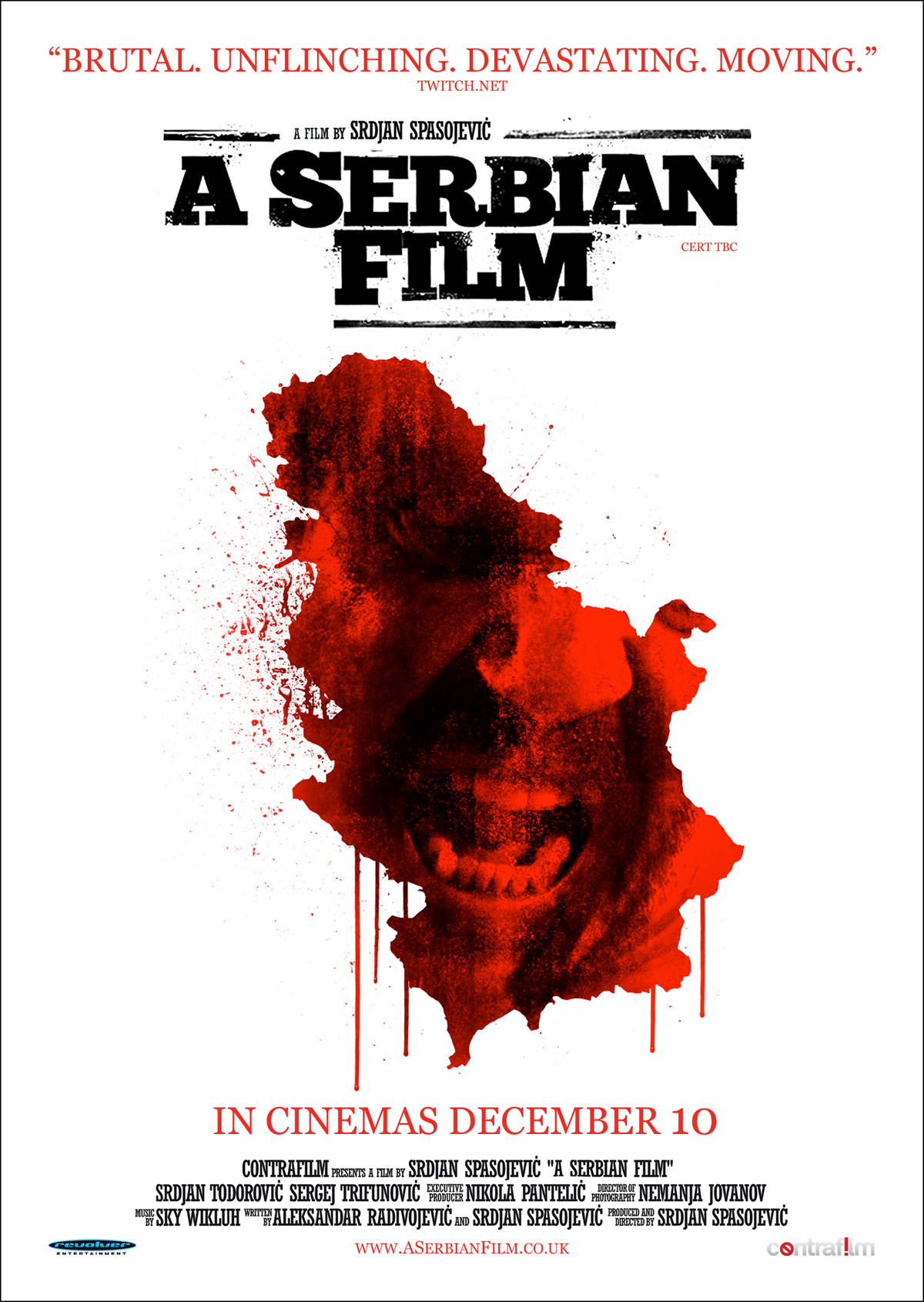
Srpski Film

a.k.a.
A Serbian Film

Srdan Spasojevic, 2010.
BBFC rating: 18 (with compulsory cuts)


One of the few films in recent years to have been refused an 18 certificate in its uncut form, Sprski Film would be interesting for that fact alone - just as last year's Gurotesuku (Grotesque) was for being rejected in its entirety. But unlike Grotesque - which was nasty, unrelenting torture with no narrative or message - A Serbian Film is a transfixing, astonishing piece of work.

The story follows Milos, a semi-retired porn actor now married with a young son. The opening scene involves this son watching one of his father's movies. (This is not by any means the film's most disturbing scene involving sex and children.) Milos is offered a final job by Vukmir, a filmmaker who wants to make a new type of porn film. The catch is that the artistic process means he's not allowed to see the script in advance; rather, he must explore the possibilities of each setup in real time, ostensibly to heighten the film's realism. However, the real reason Milos isn't shown the script is that Vukmir wants him to perform acts so illegal, immoral and reprehensible that he would never have signed up had he known. But is it too late for Milos to get out of the strictly-enforced contract?

The BBFC report makes interesting reading, but be warned that many of the more shocking scenes are described in such detail that reading it may diminish the power of the film. Having said that, the BBFC have insisted that A Serbian Film be cut by 4 minutes and 12 seconds for its theatrical and home video release so they've done a pretty good job of that themselves. Though, as I've said before, I find the BBFC's decisions thoughtful and reasonable, these decisions are restricted by the guidelines against which they judge films. The current guidelines are such that they
required forty-nine individual cuts, across eleven scenes. A number of cuts were required to remove elements of sexual violence that tend to eroticise or endorse sexual violence. Further cuts were required to scenes in which images of children are intercut with images of adult sexual activity and sexual violence.
It seems impossible that these cuts haven't softened the film's horror. In its uncut form, this is one of the most affecting, disturbing movies I've ever seen. Having little interest in supernatural 'scares', I find most horrific the films that plausibly show people battling with the worst of which humanity is capable. That's one of the reasons I tend to defend so-called torture porn. But in A Serbian Film this theme is really ramped up, because it explores the real horror of what we, through our protagonist, are capable of doing - under the right circumstances, with the right kind of nudging. Vukmir is a sociopathic Milgram, twisting and stretching Milos' free will while observing the results with an excited detachment. The results are stylishly grim, and the conclusion both appalling and inevitable.

Wednesday, 8 December 2010

Harry Potter and the Deathly Hallows part 1

David Yates, 2010. 
BBFC rating: 12A.


I finished reading the seventh Harry Potter book for the second time a couple of days ago. The first time I read it, I hated the ending, which I thought was a cop-out, a deus ex machina with a sickening and obvious postscript. Either my cynicism has mellowed or I had previously missed something - I think the latter - because I found it much less egregious this time round. Something I appreciated much more was the structure of the story. The first time I read it, it bothered me that so little was achieved within the first two thirds of the story by the trio around which the it revolves - Harry, Ron and Hermione, who are trying to locate and destroy the six horcruxes in which Voldemort has secreted parts of his soul. And the first half of this story is what this latest film adapts, so the action is sporadic, the outlook generally bleak and the achievements few and far between. But that's how projects go in the real world: it's the slog and the thinking, the exasperation and hand-wringing, that subtly creates the conditions required for its completion. And that's what we see in this film. The payoff comes in part 2, which opens next July. No doubt it, like this and all the other movies in the series, will suffer from unconvincing acting. But, like the more recent Potter adaptations, it will have some spectacular scenes of magic, death and bittersweet victory.